The excerpt explicitly describes a relevant condition, need, practice, or result. Translating it into this model remains an analytical judgment.
Trace the model back to its evidence
Evidence & Artifacts
A model should make its reasoning visible. Start with a model component, then trace its themes, categories, and descriptive codes back to quoted sources and supporting artifacts.
Open the model inventory →Visualization · Open alignment mind map ↗Browse quoted evidence ↓Read the focused cited excerptsOpen the Actionable Model ↗
24model areas inventoried
77elements explicitly aligned
55selected stored excerpts
47distinct source references
The logic of the evidence trail
From the model back to the research and artifacts.
- 01Model component
Start with a diagnostic, decision, delivery, or learning requirement and inspect its analytical rationale.
- 02Theme
Trace the model alignment to the more specific grouping recorded in the codebook.
- 03Category
Locate the broad structural grouping containing that theme and its codes.
- 04Descriptive code
Identify the concept attached to the excerpt in the existing codebook.
- 05Evidence & artifacts
Inspect the source quotation, reference, and locator, alongside linked application artifacts and development memos.
Codes describe. The model explains and organizes action.
The codebook contains 748 entries across 7 recorded categories. Codes such as Affordability, Community Digital Navigators, Data Inaccuracy/Bad Mapping, and Teachers and Educators preserve different parts of the problem. Categories and themes organize those concepts; they are not themselves a sequence of implementation phases.
The model makes an additional analytical move. Repeated access, cost, capability, trust, institutional, and support concerns become questions that must be answered before and during action. Evidence quality motivates diagnosis; complementary roles motivate stakeholder analysis; educational counterexamples motivate attention to pedagogy and outcomes; and delivery dependencies motivate the decision gate and implementation planning. The architecture integrates these concerns rather than assigning every code to one exclusive phase.
This page preserves the codebook’s stored categories and themes. The ten topical clusters in the Code Book mind map are browsing groups, distinct from that recorded taxonomy. A quotation can contribute to several model components; reuse does not constitute additional independent evidence.
What this crosswalk establishes
It documents a source-to-code-to-category-to-theme trail and explains the present alignment to the model. The final model connection is a curated analytical interpretation, not a claim that the quoted author proposed this model or validated its phase order. This is a reconstruction from the site’s current holdings; dated coding decisions, model versions, negative-case memos, and participant validation records are needed to establish the complete chronological development history.
Quotations, references, filenames, and locators are reproduced from the existing codebook. Original source files have not been independently rechecked for this page. Existing extraction artifacts and ellipses remain visible; shortened narrative samples use […].
How to read the alignment
Separate evidence from the analytical step.
The model combines concerns into a procedure, relationship, decision rule, or feedback loop. The source supports the rationale, not the exact architecture.
Cited source material is paired with an inspectable application tool. The artifact shows how the concern becomes a working record or review; it is distinguished from completed field evidence.
Visual application of the analytical process
Model → Themes → Categories → Codes
Work backwards from the model to the research behind it. Choose a model area and follow its branches from themes to categories to descriptive codes. Select a code to inspect its quoted source evidence and linked supporting artifacts, or select a model node to explore all the codes behind it.
Category and theme labels repeat on separate code branches so each visible path retains its recorded taxonomy. Edges show curated alignment, not causation or a validated development chronology.
Loading the curated alignment paths…
Scroll to explore the branches; use + and − to change scale. Code and model nodes support keyboard activation. Select “All model areas” for the complete crosswalk.
The mind map could not load. The full narrative tables and source register below retain every alignment.
The complete model inventory
Trace each part of the architecture.
Explore all 24 model areas and 77 aligned elements on a dedicated page, with searchable narratives, source links, and expandable alignment tables.
Open the complete model inventory →Why this architecture is a justified response
Three analytical transitions connect the evidence to the model.
From isolated barriers to a situated diagnosis.
The excerpts describe economic, geographic, institutional, learning, design, and support conditions. That breadth explains why Phases 1–6 frame the population, map the system, examine education and context, define architecture, and establish a baseline. This is a reasoned integration of concerns, not proof that the six phases are the only valid sequence.
From a plausible solution to a defensible commitment.
Cost, capacity, roles, usability, risk, and uncertain benefits recur in the source material. The pre-gate and six tests require those assumptions to be examined before resources are committed. Phase 7 then turns the selected option into assigned delivery work. The decision rule is the model’s contribution; its exact operation still needs documented application and evaluation.
From activity to outcomes and revision.
The OLPC evaluation supplies a counterexample to treating provision as educational success. Measurable goals, population baselines, consultation, and governance revision support the logic of Phases 8–10 and the feedback loops. A diagrammed loop does not itself demonstrate learning: records of observations, decisions, redesigns, and subsequent outcomes would show it operating.
Inspect the researcher’s visual record
Development artifacts already preserved on the site
The memo gallery offers a complementary trail of conceptual work. The descriptions below follow that gallery’s existing interpretation; inspect the original images there. Except for the 2020 title, dates and exact coding-to-version links are not recorded on the site, so these artifacts are not presented as a verified chronology.
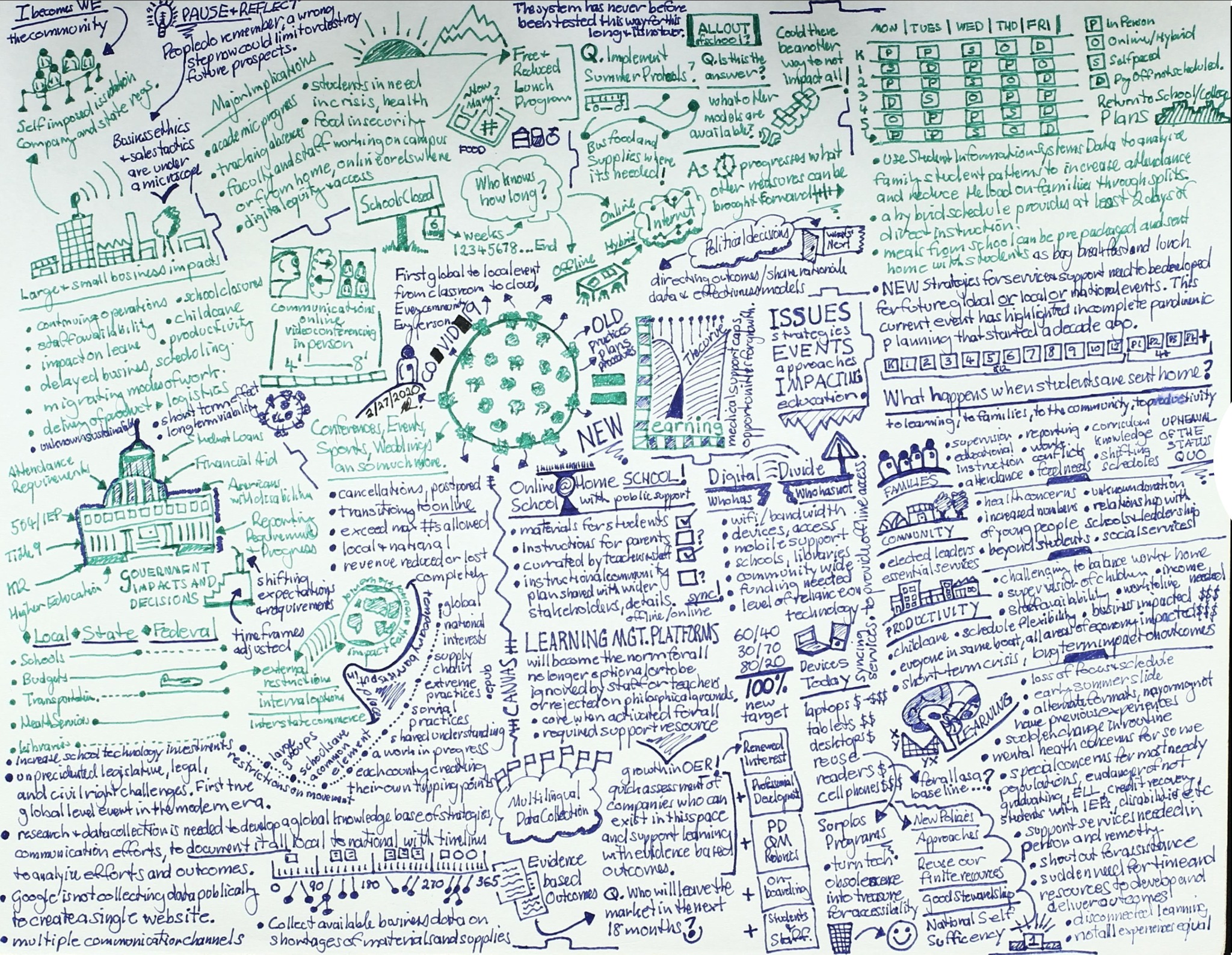
Development artifact
DD Vision 2020 ↗
Paul Ross · visual analytical memo · title records 2020The published memo gallery describes a systems scan connecting pandemic disruption with learning, households, infrastructure, support, and institutions. It provides an inspectable artifact of broad problem framing, rather than a source for an exact final-phase sequence.
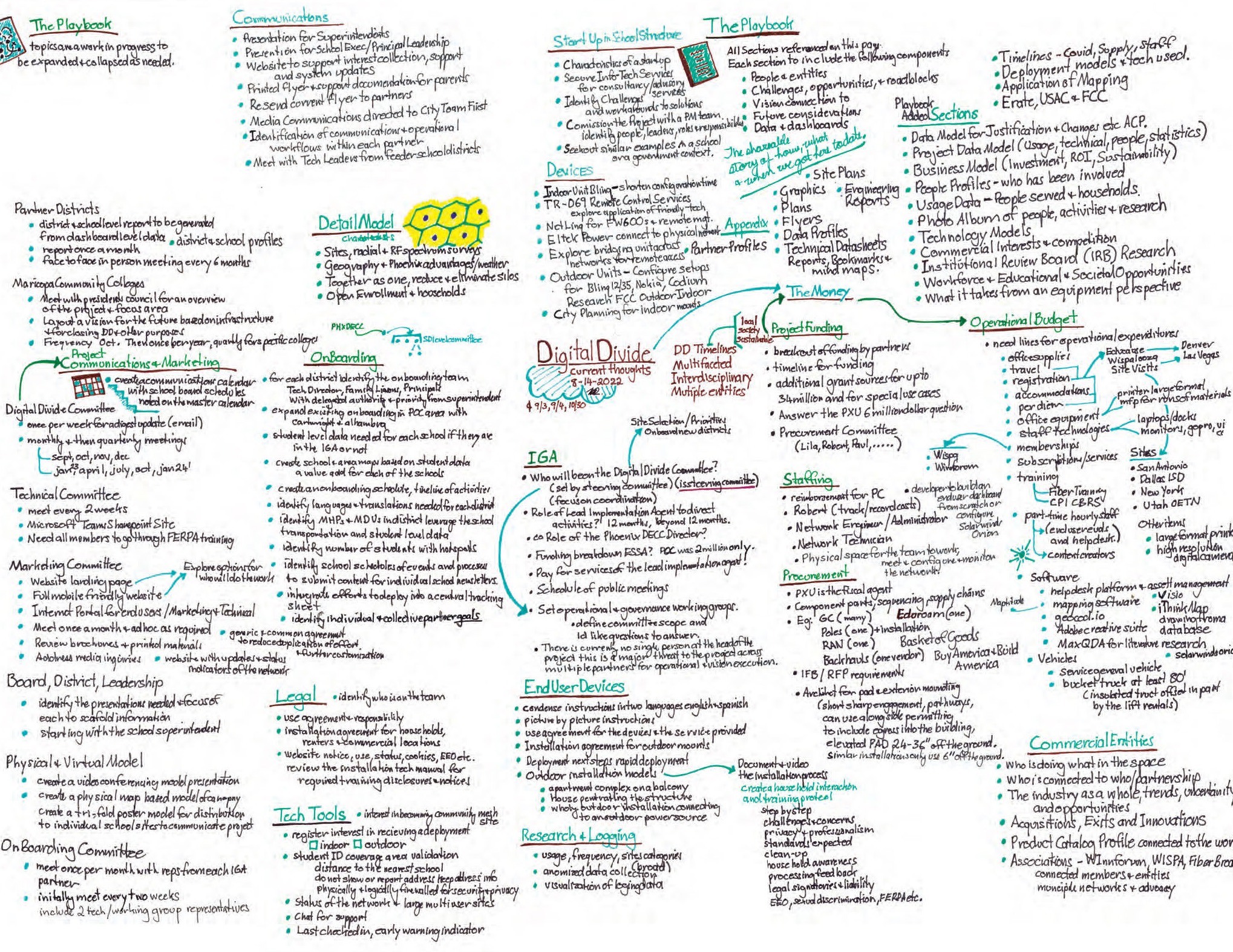
Development artifact
The Playbook ↗
Paul Ross · visual analytical memo · date not recorded on the siteThe published gallery describes governance, communication, partners, devices, staffing, procurement, funding, support, and research as interconnected workstreams. This artifact helps readers inspect the practical integration behind stakeholder, architecture, and implementation concerns.
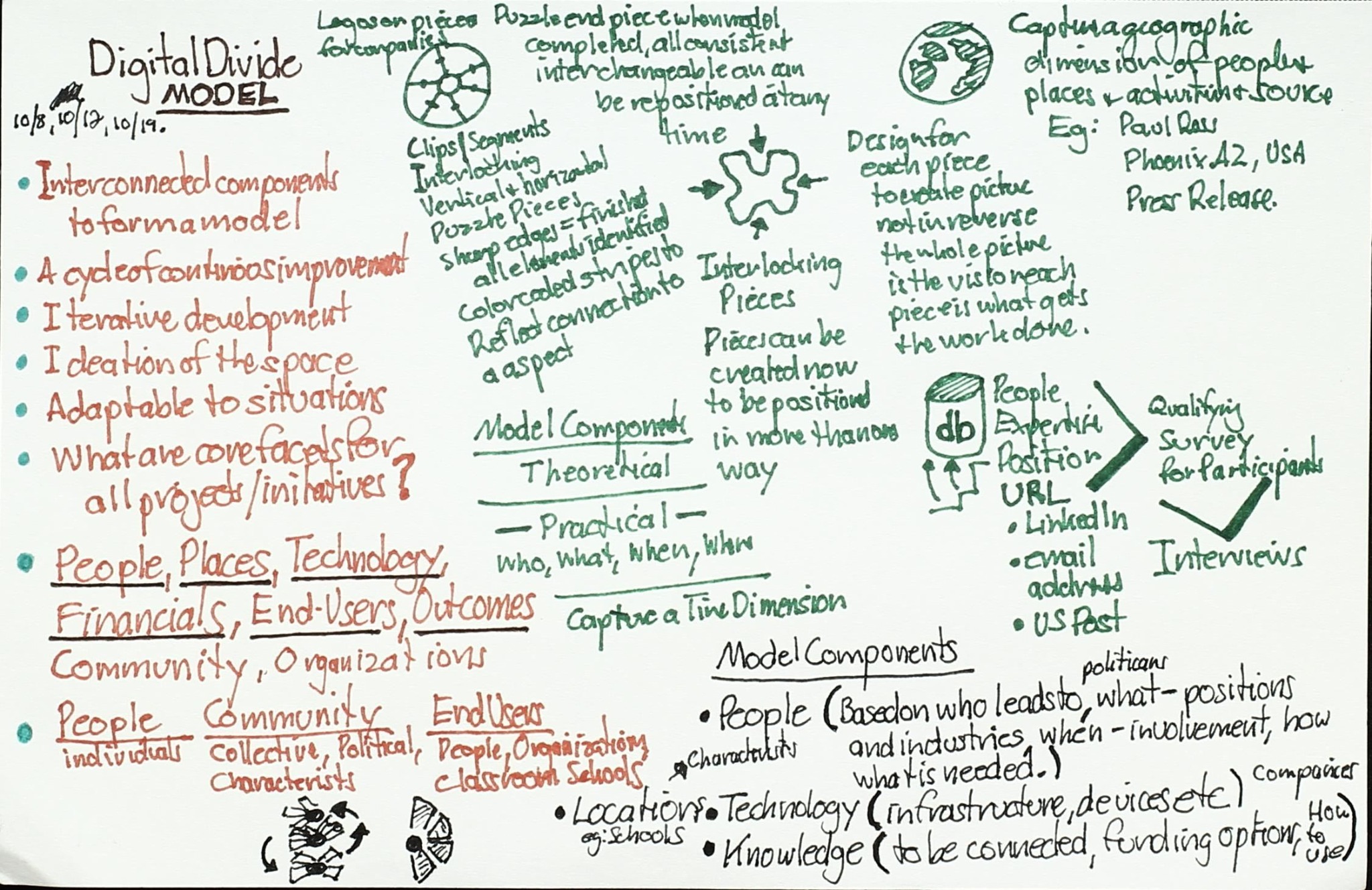
Development artifact
People, place, and technology ↗
Paul Ross · model-development working sketch · date not recorded on the siteThe published gallery describes the sketch as relating technology and infrastructure to community context, finances, end users, and intended outcomes. It is a developmental artifact to compare with the final architecture, not independent validation of its effectiveness.
From evidence to a usable record
Five supporting application artifacts
These analytical tools make five model concerns operational. Each artifact links back to collected quotations and to existing worksheets or guidance. Tables contain illustrative structures and proposed review questions, not invented research observations or completed institutional records.
Supporting application artifact
Indicator ownership and data-care matrix
Make the responsibility for defining, collecting, reviewing, and protecting each indicator visible.
Research-informed application artifact prepared for this site; not a completed field record or independent validation result.
| Indicator / record | Illustrative accountable role | Data definition and care | Decision supported |
|---|---|---|---|
| Meaningful task completion | Program lead, with a service-data steward | Define the task, eligible population, numerator, denominator, source, review frequency, and subgroup rules; retain consent and access controls. | Compare task completion with the baseline before attributing benefit to training or access. |
| Access and affordability | Connectivity lead, with a community evidence steward | Document price, service availability, reliability, measurement date, missing data, and the distinction between advertised and experienced access. | Review whether a service remains usable for the priority population. |
| Accessible participation and support | Accessibility lead, with participant representatives | Record task barriers, assistance needed, feedback, reporting cadence, and privacy protections; name the person authorized to act. | Assign an adjustment and check whether the barrier was reduced. |
Collected source trailFederal Government Agencies(Congressional Research Service, 2021b, PDF p. 6)State/Local Governments and Broadband Offices(National Telecommunications and Information Administration, n.d.-a, transcript ¶27)Solution: Public-Private Partnerships(UN-Habitat, 2024, PDF p. 80)Community-Based Digital Literacy Training(UN-Habitat, 2021, PDF p. 38)Ethnic Minorities and People of Color(California Department of Technology, 2023, PDF p. 94)
Existing supporting artifacts
- Existing Phase 8 worksheet · indicators, source, frequency, owner, and data care ↗Researcher-authored application worksheet
- Practitioner Guide · define evidence and assign ownership ↗Existing practical interpretation
Roles are illustrative responsibilities to assign locally. This artifact operationalizes the cited rationale; it does not show that a particular institution has adopted these assignments.
Supporting application artifact
Dashboard, evidence register, and support workflow
Connect an indicator display to the source record and the action it is meant to inform.
Research-informed application artifact prepared for this site; not a completed field record or independent validation result.
| Working record | Minimum fields | Review or action |
|---|---|---|
| Indicator panel | Indicator; baseline; target; current value; date; subgroup; owner; source; uncertainty. | Review change against a defined baseline rather than treating activity as impact. |
| Source and evidence register | Document or dataset; locator; collection date; population; definition; limitations; version; steward. | Make each displayed claim returnable to its source and note incomplete coverage. |
| Support and correction log | Barrier or request; participant context; assigned role; action; due date; follow-up; outcome. | Convert a reported difficulty into assigned assistance and a recorded follow-up. |
Collected source trailTelehealth Access Points(Arizona Commerce Authority, 2024, PDF p. 17)Data Inaccuracy/Bad Mapping(Congressional Research Service, 2020a, PDF p. 2)Community Digital Navigators(National Digital Inclusion Alliance, 2024, PDF p. 47)Federal Government Agencies(Congressional Research Service, 2021b, PDF p. 6)
Existing supporting artifacts
- Existing Phase 8 worksheet · indicator specification and review/data care ↗Researcher-authored application worksheet
- Existing Phase 9 worksheet · implementation, baseline comparison, and assigned response ↗Researcher-authored application worksheet
The source plan explicitly proposes a dashboard. The evidence register and support-log schema above are analytical applications, not quoted requirements from that plan. No invented current values or targets are supplied.
Supporting application artifact
Four-perspective participation scorecard
Keep delivery, meaningful participation, distribution, and durability visible together.
Research-informed application artifact prepared for this site; not a completed field record or independent validation result.
| Perspective | Example evidence to examine | Question for review |
|---|---|---|
| Delivery and service performance | Installed or distributed resources; milestones; reliability; support requests. | What was delivered, and did the service perform as intended? |
| Use and meaningful participation | Task completion; adoption; participant experience; sustained use. | Did people achieve an intended activity, rather than only receive an input? |
| Distribution and safeguards | Subgroup baselines; accessibility barriers; language needs; privacy and trust concerns. | Who benefited, who still encounters barriers, and what burden or harm appeared? |
| Durability and institutional capacity | Operating and replacement costs; staffing; partner commitments; maintenance. | Can the service and its benefits continue under real operating conditions? |
Collected source trailDigital Equity Plans/Bill of Rights(City and Borough of Juneau Assembly, 2023, transcript ¶14)Community-Based Digital Literacy Training(UN-Habitat, 2021, PDF p. 38)Ethnic Minorities and People of Color(California Department of Technology, 2023, PDF p. 94)Digital Devices(Cueto et al., 2025, PDF p. 2)Deployment Costs(Tucker et al., 2018, PDF p. 4)
Existing supporting artifacts
- Existing Phase 9 worksheet · compare results and decide an operational response ↗Researcher-authored application worksheet
- Existing Phase 10 worksheet · outcomes and continuous improvement ↗Researcher-authored application worksheet
The collected transcript names a scorecard. These four perspectives are an analytical organization informed by the cited sources, not an assertion that Alaska used this exact instrument. No results are claimed.
Supporting application artifact
Disinformation and trust safeguard register
Translate a documented information risk into an explicit design and review responsibility.
Research-informed application artifact prepared for this site; not a completed field record or independent validation result.
| Risk or barrier | Proposed control to examine | Evidence to retain |
|---|---|---|
| AI-generated false or misleading content | Use source checks, provenance information, media-literacy support, and human review for consequential content. | Source and date; verification steps; correction; reviewer; observed effect on the task. |
| Deepfake impersonation and deceptive messages | Offer a trusted verification route and accessible guidance; assign responsibility for escalating suspected impersonation. | Report; verification route; assigned response; communication; follow-up. |
| Language, confidence, or accessibility barriers to verification | Test instructions with affected users and provide culturally relevant, accessible support. | Participant feedback; language/accessibility needs; design revision; unresolved concerns. |
Collected source trailAI and Deepfakes(United Nations Development Programme, 2024, PDF p. 14)Algorithmic and AI Bias(OECD, 2025, PDF p. 11)Digital Citizenship Curricula(e.Republic, 2021, PDF p. 2)Barrier-CUL(Chomunorwa et al., 2023, PDF p. 7)
Existing supporting artifacts
- Existing Phase 4 worksheet · contextual conditions and risks ↗Researcher-authored application worksheet
- Existing Decision Gate worksheet · safeguards and fit ↗Researcher-authored application worksheet
UNDP documents the risk to trust. The controls and record fields are proposed analytical responses to examine and adapt; this is not a record of observed incidents or tested mitigation effectiveness.
Supporting application artifact
Solution stage and readiness review
Separate an announced idea, a pilot, an operating service, and a supported decision to expand.
Research-informed application artifact prepared for this site; not a completed field record or independent validation result.
| Stage | Evidence to request | Decision discipline |
|---|---|---|
| Proposed or announced | Statement of intended action, population, partner engagement, funding assumptions, and unresolved dependencies. | Describe plans as plans; avoid counting an announcement as delivered adoption. |
| Pilot or limited deployment | Scope; participants; delivery record; support needs; baseline; observed issues and results. | Test assumptions and record changes before expanding the scope. |
| Operating service | Performance and participation evidence; staffing; maintenance; data care; governance and recurring resources. | Check whether the service functions and remains usable in its actual setting. |
| Expansion or sustained operation | Repeated outcome observations, cost and capacity evidence, safeguards, and a documented review decision. | Treat expansion as a justified decision, not proof of accelerated adoption or effectiveness. |
Collected source trailAffordable Housing Wiring(Arkansas State Broadband Office (ARConnect), 2023, PDF p. 86)State Broadband Offices/Task Forces(Institute for Local Self-Reliance & National Digital Inclusion Alliance, 2022, transcript ¶284)Open-Access Middle-Mile(California Department of Technology, 2023, PDF p. 41)Digital Devices(Cueto et al., 2025, PDF p. 2)
Existing supporting artifacts
- Existing Phase 7 worksheet · implementation design and readiness ↗Researcher-authored application worksheet
- Existing Decision Gate worksheet · evaluate before commitment ↗Researcher-authored application worksheet
- Existing Phase 10 worksheet · sustain, adapt, or retire ↗Researcher-authored application worksheet
The collected plan documents a proposed pilot, and the delivery source records implementation work. The stage sequence is an application framework, not a maturity scale validated by those documents.
Read the underlying material
Focused source & quotation register
55 selected excerpts from 47 distinct references, connected to their existing descriptive codes. Each record preserves its category, theme, citation, document, and locator. Sources include policy and planning documents, scholarship, practitioner material, and public transcripts; their purposes and evidentiary strengths differ.
A planned action in a policy document is evidence of an intention or requirement, not proof of achieved impact. A commentary excerpt is an interpretation. A study’s finding applies to its own design and setting.
55 excerpts
01Affordability(Slivka, 2023, PDF p. 2)
Stored verbatim excerpt
Open source URL as recorded ↗“It is more crucial than ever for people to have access to, and the skills to use, computers, tablets, smartphones, and the internet. There are a variety of reasons that the digital divide exists, from a lack of built infrastructure and income restrictions to a lack of education, information, and device availability. In a state as diverse as Maryland, these barriers are also compounded by a shortage of appropriate cultural and language services that make accessing services more …”
(Slivka, 2023, PDF p. 2)
- Descriptive code · CB0008Affordability
- Recorded categoryBarriers and Challenges
- Recorded themeAffordability and Cost
- Contribution to the model
The divide combines infrastructure, income, education, information, devices, and cultural or language services.
Used in: Phase 1 · Phase 6 · Gate · 1 · Across all phases
02Affordability(UN-Habitat, 2021, PDF p. 17)
Stored verbatim excerpt
“Communities that are known to be disproportionately affected by the digital divide include: ● Women and girls ● Children and youth ● Older people ● Urban and rural poor ● Marginalised or minority communities ● Persons with disabilities ● Indigenous communities and First Nations ● Refugees and persons on the move Understanding the digital divide There are many dimensions of the digital divide, which can vary from the physical to the psychological. The previous playbook, “Assessing the Digital Divide” identified six main types, though any city can display a combination of them.”
(UN-Habitat, 2021, PDF p. 17)
The codebook does not record a source URL for this excerpt; use the full reference and document name above.
- Descriptive code · CB0008Affordability
- Recorded categoryBarriers and Challenges
- Recorded themeAffordability and Cost
- Contribution to the model
Population and context must be specified; exclusion has several dimensions.
04Community-Based Digital Literacy Training(UN-Habitat, 2021, PDF p. 38)
Stored verbatim excerpt
“● Priorities: The plan’s key priorities for your community’s unique situation, for example: cost reduction, equitable internet connectivity, increased digital literacy for seniors or accessible devices for persons with disabilities. ● Goals, outcomes: The goals and outcomes expected to be achieved by the plan’s activities. This can include targets with measurable outcomes, such as a certain percentage of neighborhoods gaining access to broadband internet, or a percentage of a specific demographic receiving digital literacy training.”
(UN-Habitat, 2021, PDF p. 38)
The codebook does not record a source URL for this excerpt; use the full reference and document name above.
- Descriptive code · CB0129Community-Based Digital Literacy Training
- Recorded categorySolutions and Initiatives
- Recorded themeDigital Literacy, Education, and Workforce Development
- Contribution to the model
Community priorities and measurable goals connect local needs to a plan.
Used in: Phase 1 · Pre-gate · Gate · 2 · Gate · Outcomes · Phase 7 · Phase 8 · Phase 9 · Across all phases
05Complex Interface Design (UI/UX)(United Nations Development Programme, 2024, PDF p. 48)
Stored verbatim excerpt
“The Digital Agency of Japan collaborates with private design firms to train government staff in user experience and user interface (UX/UI) design, accessibility, and user testing methodologies.”
(United Nations Development Programme, 2024, PDF p. 48)
The codebook does not record a source URL for this excerpt; use the full reference and document name above.
- Descriptive code · CB0136Complex Interface Design (UI/UX)
- Recorded categoryBarriers and Challenges
- Recorded themeAccessibility, Language, Usability, and Cultural Fit
- Contribution to the model
Accessibility, user experience, and user testing require institutional capability.
Used in: Phase 5 · Gate · 4 · Across all phases · Across all phases · Across all phases
06Data Inaccuracy/Bad Mapping(Congressional Research Service, 2020a, PDF p. 2)
Stored verbatim excerpt
Open source URL as recorded ↗“Current data on national broadband availability is provided by private telecommunications providers, collected by the FCC, and displayed on the FCC’s Fixed Broadband Deployment Map. Difficulty in accurately mapping broadband availability has been attributed to a number of factors, including the adequacy of census block data, the lack of independent data validation outside the FCC, and the absence of a challenge process for consumers and other entities that believe the Fixed Broadband Deployment Map may overstate availability in their area.”
(Congressional Research Service, 2020a, PDF p. 2)
- Descriptive code · CB0157Data Inaccuracy/Bad Mapping
- Recorded categoryBarriers and Challenges
- Recorded themeMapping, Data Quality, and Measurement
- Contribution to the model
Availability data can be unreliable without granular data, validation, and challenge mechanisms.
Used in: Phase 1 · Phase 5 · Phase 6 · Gate · Outcomes · Phase 8 · Feedback · Reframing · Across all phases
07Data Protection and Privacy Laws(UN-Habitat, 2024, PDF p. 57)
Stored verbatim excerpt
“However, concerns about the data privacy, security, and affordability of smart city applications are frequently highlighted, alongside an uneven distribution of these services across regions. The analysis suggests that the success of smart applications for city services hinges on both technical capabilities and local socio-economic and cultural contexts.”
(UN-Habitat, 2024, PDF p. 57)
The codebook does not record a source URL for this excerpt; use the full reference and document name above.
- Descriptive code · CB0160Data Protection and Privacy Laws
- Recorded categoryLegislation and Policy
- Recorded themePrivacy, Data Protection, Cybersecurity, and AI Governance
- Contribution to the model
Technical capabilities and local socioeconomic and cultural contexts jointly shape service success.
Used in: Phase 1 · Phase 4 · Feedback · Reframing
08Deployment Costs(Tucker et al., 2018, PDF p. 4)
Stored verbatim excerpt
“ Many areas served by electric cooperatives are characterized by low population density causing broadband deployment costs per cooperative household to be so high that private carrier returns often cannot justify the costs of deployment.”
(Tucker et al., 2018, PDF p. 4)
The codebook does not record a source URL for this excerpt; use the full reference and document name above.
- Descriptive code · CB0172Deployment Costs
- Recorded categoryBarriers and Challenges
- Recorded themeInfrastructure, Coverage, and Reliability
- Contribution to the model
Low population density can make deployment commercially difficult.
Used in: Phase 4 · Phase 6 · Pre-gate · Gate · 3 · Gate · 6 · Across all phases · Across all phases · Across all phases
09Digital Citizenship Curricula(e.Republic, 2021, PDF p. 2)
Stored verbatim excerpt
“The centers also offer digital citizenship training to help residents learn about topics like internet safety, data security, and privacy.”
(e.Republic, 2021, PDF p. 2)
The codebook does not record a source URL for this excerpt; use the full reference and document name above.
- Descriptive code · CB0195Digital Citizenship Curricula
- Recorded categorySolutions and Initiatives
- Recorded themeDigital Literacy, Education, and Workforce Development
- Contribution to the model
Digital citizenship includes safety, data security, and privacy.
Used in: Gate · 5 · Across all phases
10Digital Public Infrastructure(United Nations General Assembly, 2024, PDF p. 5)
Stored verbatim excerpt
“16. We consider such digital public goods and digital public infrastructure to be key drivers of inclusive digital transformation and innovation. We recognize the need to increase investment in their successful development with the participation of all stakeholders.”
(United Nations General Assembly, 2024, PDF p. 5)
The codebook does not record a source URL for this excerpt; use the full reference and document name above.
- Descriptive code · CB0243Digital Public Infrastructure
- Recorded categoryTechnologies and Infrastructure
- Recorded themeDigital Government, Identity, and Public Infrastructure
- Contribution to the model
Infrastructure development calls for investment and stakeholder participation.
Used in: Phase 2 · Pre-gate · Across all phases · Across all phases
11Digital Public Infrastructure(United Nations Development Programme, 2024, PDF p. 10)
Stored verbatim excerpt
“Digital Economy Mentorship and micro-financing for underrepresented communities Digital Public Infrastructure, e.g. identity and payment systems (in collaboration with private sector) Digital Society Assistive tools for persons with disabilities Platforms for policy feedback, consultation and co-creation *Examples for illustrative purpose POPULATION ARCHETYPES LEVERS WHOLE-OF-SOCIETY EFFORT Private Sector Public Sector People Sector”
(United Nations Development Programme, 2024, PDF p. 10)
The codebook does not record a source URL for this excerpt; use the full reference and document name above.
- Descriptive code · CB0243Digital Public Infrastructure
- Recorded categoryTechnologies and Infrastructure
- Recorded themeDigital Government, Identity, and Public Infrastructure
- Contribution to the model
The playbook lists consultation, policy feedback, co-creation, and whole-of-society participation as illustrative levers.
Used in: Phase 2 · Pre-gate · Phase 10 · Feedback · Internal
Digital equity plan12Ethnic Minorities and People of Color(California Department of Technology, 2023, PDF p. 94)
Stored verbatim excerpt
“Baseline: While 46% of overall telephone survey respondents use telehealth, a slightly lower percentage (43%) of those who identify as racial or ethnic minorities say the same. 223”
(California Department of Technology, 2023, PDF p. 94)
The codebook does not record a source URL for this excerpt; use the full reference and document name above.
- Descriptive code · CB0280Ethnic Minorities and People of Color
- Recorded categoryDemographics and People
- Recorded themeRacial, Ethnic, Indigenous, and Tribal Communities
- Contribution to the model
A subgroup comparison illustrates why a baseline should retain population differences.
13E-Waste and Sustainability(UN-Habitat, 2021, PDF p. 50)
Stored verbatim excerpt
“● Create digital device recycling/refurbishing programs where digital devices used by city staff are refurbished and provided at low-cost or no-cost to residents”
(UN-Habitat, 2021, PDF p. 50)
The codebook does not record a source URL for this excerpt; use the full reference and document name above.
- Descriptive code · CB0286E-Waste and Sustainability
- Recorded categoryLegislation and Policy
- Recorded themeGeneral or Cross-Cutting Policy
- Contribution to the model
Device reuse creates a concrete lifecycle and affordability response.
14Fear/Resistance to Technology(Bentley et al., 2024, PDF p. 1)
Stored verbatim excerpt
Open source URL as recorded ↗“Results indicated that measures of digital confidence were predicted by structural, behavioural, and psychologi- cal differences, such that women, older people, those on lower salaries, people with less digital access, and those with lower digital well-being, reported significantly less digital confidence. Furthermore, digital confidence significantly moderated the relationship between people’s experiences with everyday AI technologies and their general attitudes towards AI.”
(Bentley et al., 2024, PDF p. 1)
- Descriptive code · CB0291Fear/Resistance to Technology
- Recorded categoryBarriers and Challenges
- Recorded themeDigital Literacy, Skills, and Confidence
- Contribution to the model
Confidence varies with structural, behavioral, and psychological conditions; its reported relationship with AI attitudes matters for readiness.
15Global AI Governance(Force for Good Initiative, 2025, PDF p. 4)
Stored verbatim excerpt
“The Global Digital Compact is based on the principle that technology should benefit everyone. It includes the first truly universal agreement on the international governance of artificial intelligence. It commits Governments to establishing an independent international Scientific Panel on AI and initiating a global dialogue on its governance within the United Nations. The Global Digital Compact represents the first collective effort to reach agreed interoperability standards - essential for consistent measurement. And it supports networks and partnerships to build capacity on AI in developing countries.”
(Force for Good Initiative, 2025, PDF p. 4)
The codebook does not record a source URL for this excerpt; use the full reference and document name above.
- Descriptive code · CB0325Global AI Governance
- Recorded categoryLegislation and Policy
- Recorded themePrivacy, Data Protection, Cybersecurity, and AI Governance
- Contribution to the model
The report connects interoperability standards, measurement, partnerships, and capacity.
Used in: Phase 5 · Gate · 4 · Across all phases
Digital equity plan16Individuals with Disabilities(Connecticut Commission for Educational Technology, 2023, PDF p. 84)
Stored verbatim excerpt
“Focus group participants described a need for technical support professionals who had experience working with people with disabilities. General technical support staff may not be sensitive to the needs of individuals with disabilities. They may also be unaware of or unfamiliar with the assistive technology that some individuals with disabilities use.121”
(Connecticut Commission for Educational Technology, 2023, PDF p. 84)
The codebook does not record a source URL for this excerpt; use the full reference and document name above.
- Descriptive code · CB0375Individuals with Disabilities
- Recorded categoryDemographics and People
- Recorded themePeople with Disabilities and Accessibility Needs
- Contribution to the model
General technical assistance may not meet disability-specific needs.
Used in: Phase 3 · Phase 6 · Phase 10 · Across all phases
17Lack of Infrastructure/Topography(OECD, 2025, PDF p. 12)
Stored verbatim excerpt
Open source URL as recorded ↗“Some challenges are more prevalent in some functions than others. For instance, tax administration faces complex laws and rules around tax processes and data, whereas public procurement struggles with a lack of established rules around AI. Finally, the use of AI in functions such as public financial management is constrained by outdated legacy technology infrastructure unsuitable for AI development or use.”
(OECD, 2025, PDF p. 12)
- Descriptive code · CB0417Lack of Infrastructure/Topography
- Recorded categoryBarriers and Challenges
- Recorded themeInfrastructure, Coverage, and Reliability
- Contribution to the model
Procurement rules and legacy infrastructure can constrain institutional use of AI.
Used in: Phase 4 · Phase 5 · Phase 6 · Gate · 3 · Gate · Outcomes · Across all phases · Across all phases
Digital equity plan18Open-Access Middle-Mile(California Department of Technology, 2023, PDF p. 41)
Stored verbatim excerpt
“• Middle-Mile Broadband Initiative (MMBI): $3.25 billion was allocated to CDT to oversee the development, construction, maintenance, and operation of a statewide open-access middle-mile network through the MMBI. Significant progress has been made on the 10,000-mile plus MMBI project, which includes contracts for building, leasing, and purchasing segments of the network, as well as procurement of thousands of miles of conduit and fiber to mitigate potential supply chain risks.”
(California Department of Technology, 2023, PDF p. 41)
The codebook does not record a source URL for this excerpt; use the full reference and document name above.
- Descriptive code · CB0538Open-Access Middle-Mile
- Recorded categorySolutions and Initiatives
- Recorded themeCommunity, Municipal, Cooperative, and Open-Access Networks
- Contribution to the model
A documented initiative connects assigned responsibility, construction, maintenance, procurement, and supply-chain risk.
Used in: Phase 4 · Phase 5 · Pre-gate · Phase 7 · Phase 9 · Across all phases
19Public-Private Partnerships(Congressional Research Service, 2020b, PDF p. 11)
Stored verbatim excerpt
Open source URL as recorded ↗“In return, the broadband provider brings its technical expertise, innovation, equipment, and capital investment into under- or unserved areas in the community. In the end, both partners share the risks and costs of broadband deployment.”28 The North Carolina Broadband Infrastructure Office offers several examples of potential public-private partnerships: For example, a city or county may offer a cost-sharing opportunity to broadband providers, in which the municipality contributes an agreed upon portion of the costs of broadband expansion to an under- or unserved region.”
(Congressional Research Service, 2020b, PDF p. 11)
- Descriptive code · CB0570Public-Private Partnerships
- Recorded categorySolutions and Initiatives
- Recorded themePublic-Private Partnerships and Cross-Sector Coalitions
- Contribution to the model
Partners contribute different resources and share deployment costs and risks.
Used in: Phase 2 · Phase 4 · Pre-gate · Gate · 3 · Gate · Outcomes · Phase 7 · Across all phases · Across all phases
20Schools and School Districts(Nazareno et al., 2022, PDF p. 9)
Stored verbatim excerpt
Open source URL as recorded ↗“Some school districts across the nation have equipped school buses with routers or mobile hotspots to bring connectivity to unserved pop- ulations.44 Likewise, public libraries and other public institutions have opened their Wi-Fi networks to be accessible from parking lots in these facilities.45 Further, several schools provided laptops and tablets to students in 2020. Equipment provision is especially valuable in rural areas with- out adequate access and where families rely on mobile internet data plans to connect,which significantly …”
(Nazareno et al., 2022, PDF p. 9)
- Descriptive code · CB0593Schools and School Districts
- Recorded categoryOrganizations and Entities
- Recorded themeEducational Institutions and Community Anchor Institutions
- Contribution to the model
Learning access extends beyond school buildings to transport, libraries, and home conditions.
Used in: Phase 3
21Solution: Public-Private Partnerships(UN-Habitat, 2024, PDF p. 80)
Stored verbatim excerpt
“Establish structural and procedural arrangements to enhance the multilevel governance of smart city initiatives: municipal and national administration should revise their multilevel configurations and processes to foster knowledge and data sharing among public organizations, enhance the coordination of complementary policies and regulations, and promote long-term programs in support of people-centred smart city development.”
(UN-Habitat, 2024, PDF p. 80)
The codebook does not record a source URL for this excerpt; use the full reference and document name above.
- Descriptive code · CB0620Solution: Public-Private Partnerships
- Recorded categorySolutions and Initiatives
- Recorded themePublic-Private Partnerships and Cross-Sector Coalitions
- Contribution to the model
Coordination, procedural arrangements, data sharing, and long-term programs are explicit governance concerns.
Used in: Phase 2 · Gate · 6 · Phase 7 · Phase 8 · Phase 9 · Phase 10 · Feedback · Internal · Across all phases · Across all phases
22State Broadband Offices/Task Forces(Institute for Local Self-Reliance & National Digital Inclusion Alliance, 2022, transcript ¶284)
Stored verbatim excerpt
“And really the thing to keep in mind overall with the American Rescue Plan money is that the money is going to the states, and different states are coming up with different rules about how they will distribute it. And so it's important for community broadband advocates at the local level to really be engaged with their state broadband offices and policymakers around how these grant programs are being formed and what the deadlines are for submitting grants and what have you.”
(Institute for Local Self-Reliance & National Digital Inclusion Alliance, 2022, transcript ¶284)
The codebook does not record a source URL for this excerpt; use the full reference and document name above.
- Descriptive code · CB0629State Broadband Offices/Task Forces
- Recorded categoryLegislation and Policy
- Recorded themeDigital Equity Plans, Capacity Grants, and Inclusion Strategies
- Contribution to the model
Rules, grant-formation processes, deadlines, and local engagement influence what is feasible.
Used in: Phase 4 · Gate · 3 · Gate · Outcomes · Phase 7 · Across all phases · Across all phases
23State/Local Governments and Broadband Offices(National Telecommunications and Information Administration, n.d.-a, transcript ¶27)
Stored verbatim excerpt
“So, how does the state participate in the Digital Equity Act programs? Well, the first step is that the governor or the equivalence official in each state needs to select an administering entity to develop the state's digital equity plan and ultimately to administer the capacity grants that will be used to implement that plan.”
(National Telecommunications and Information Administration, n.d.-a, transcript ¶27)
The codebook does not record a source URL for this excerpt; use the full reference and document name above.
- Descriptive code · CB0632State/Local Governments and Broadband Offices
- Recorded categoryOrganizations and Entities
- Recorded themeGovernment Agencies and Regulators
- Contribution to the model
An administering entity gives a concrete example of responsibility for planning and delivery.
Used in: Phase 2 · Gate · 3 · Phase 7 · Phase 8 · Across all phases
24Trust and Cultural Barriers(Institute for Local Self-Reliance & National Digital Inclusion Alliance, 2022, transcript ¶131)
Stored verbatim excerpt
“These could be legal, like current ISP contracts, physical, like a geographic location, emotional barriers, like skepticism and lack of trust, as well as socioeconomic and anything else distinctive to your community. Think about and engage with trusted institutions.”
(Institute for Local Self-Reliance & National Digital Inclusion Alliance, 2022, transcript ¶131)
The codebook does not record a source URL for this excerpt; use the full reference and document name above.
- Descriptive code · CB0705Trust and Cultural Barriers
- Recorded categoryBarriers and Challenges
- Recorded themeAccessibility, Language, Usability, and Cultural Fit
- Contribution to the model
Legal, physical, emotional, and socioeconomic barriers require local investigation and trusted institutions.
Used in: Phase 1 · Phase 2 · Phase 4 · Phase 6 · Across all phases · Across all phases · Across all phases
25Web Accessibility Standards(PayIt, 2023, PDF p. 5)
Stored verbatim excerpt
“For residents with disabilities, there are often challenges when it comes to accessing government services. These challenges come in many forms. Barriers like lack of video captions, poor color contrast, lack of alt text for images, and complex navigation hinder digital inclusion efforts and maintain the digital divide.”
(PayIt, 2023, PDF p. 5)
The codebook does not record a source URL for this excerpt; use the full reference and document name above.
- Descriptive code · CB0735Web Accessibility Standards
- Recorded categoryTechnologies and Infrastructure
- Recorded themeEducation Technology, VR/AR, OER, Evaluation Online Rubrics, and Learning Platforms
- Contribution to the model
Specific design failures can obstruct access for people with disabilities.
Used in: Phase 1 · Phase 3 · Phase 5 · Gate · 2 · Gate · 5 · Across all phases · Across all phases
26Algorithmic and AI Bias(OECD, 2025, PDF p. 11)
Stored verbatim excerpt
Open source URL as recorded ↗“There is no such thing as risk-free AI adoption. Unlocking AI’s benefits requires mitigating its risks. Biased algorithms can result in adverse outcomes; AI misuse can infringe on or prevent the free exercise of human rights; insufficient transparency, explainability and public understanding of AI can erode accountability and cause public resistance; and the over-reliance on AI can widen digital divides and allow systemic errors to propagate, weakening citizen trust in government.”
(OECD, 2025, PDF p. 11)
- Descriptive code · CB0034Algorithmic and AI Bias
- Recorded categoryBarriers and Challenges
- Recorded themeBias, Redlining, Discrimination, and Inequality
- Contribution to the model
Adoption can create adverse outcomes, rights risks, systemic errors, and distrust.
Used in: Phase 1 · Phase 4 · Phase 5 · Pre-gate · Gate · 5 · Gate · Outcomes · Phase 7 · Phase 9 · Phase 10 · Across all phases
27Digital Devices(Cueto et al., 2025, PDF p. 2)
Stored verbatim excerpt
Open source URL as recorded ↗“This paper examines a large-scale randomized evaluation of the One Laptop Per Child (OLPC) program in 531 Peruvian rural primary schools. We use administrative data on academic performance and grade progression over 10 years to estimate the long-run effects of increased computer access on (i) school performance over time and (ii) students’ educational trajectories. Following schools over time, we find no significant effects on academic performance but some evidence of negative effects on grade progression. Following students over time, we find no significant effects on…”
(Cueto et al., 2025, PDF p. 2)
- Descriptive code · CB0197Digital Devices
- Recorded categoryTechnologies and Infrastructure
- Recorded themeDevices, Hardware, Hotspots, and Assistive Technologies
- Contribution to the model
A long-run evaluation demonstrates why computer provision and educational outcomes must be assessed separately.
Used in: Phase 1 · Phase 3 · Phase 4 · Phase 5 · Pre-gate · Gate · 1 · Gate · Outcomes · Phase 7 · Phase 9 · Phase 10 · Feedback · Internal · Feedback · Reframing · Across all phases
28Civil Society/NGOs(Kanvaria & Yadav, 2025, PDF p. 1)
Stored verbatim excerpt
“In addition, the paper demonstrates the significance of the interagency collaboration between the government and non-governmental organizations and the corporate sector as regards their sustainability and scalability of ICT-based projects. Barriers of connectivity (cultural resistance and cost of digital tools) are also noted as a challenge in the paper and methods of addressing the barriers involving context-specific and inclusive strategies are proposed.”
(Kanvaria & Yadav, 2025, PDF p. 1)
The codebook does not record a source URL for this excerpt; use the full reference and document name above.
- Descriptive code · CB0111Civil Society/NGOs
- Recorded categoryOrganizations and Entities
- Recorded themeNonprofits, Advocacy Groups, and Civil Society
- Contribution to the model
The source connects interagency collaboration with scalability, sustainability, and contextual strategies.
Digital equity plan29Community-Owned Networks(Ohio Department of Development, 2024, PDF p. 24)
Stored verbatim excerpt
“Communities across Ohio have developed locally owned networks, which are often able to offer high-speed, reliable internet access at costs lower than most internet service providers would offer for the same quality service. These networks not only serve as a tool for increasing affordable access, but they also encourage competition, foster consumer choice, and drive local and regional economic development38. “Community- Owned Broadband Networks” on page 72 lists community-owned networks across the state that may be available for local government, businesses, and residents.”
(Ohio Department of Development, 2024, PDF p. 24)
The codebook does not record a source URL for this excerpt; use the full reference and document name above.
- Descriptive code · CB0134Community-Owned Networks
- Recorded categoryOrganizations and Entities
- Recorded themeCommunity Networks, Cooperatives, and Municipal Providers
- Contribution to the model
Community-owned networks provide an example linking ownership, affordability, competition, and choice.
Used in: Phase 4 · Pre-gate · Phase 7 · Across all phases · Across all phases
30Barrier-CUL(Chomunorwa et al., 2023, PDF p. 7)
Stored verbatim excerpt
Open source URL as recorded ↗“4.3.2 Usability Language issue According to Ofusori (2021), challenges that are often overlooked in the South African education system include the language barrier, as English dominates the digital space even though it is not the native language of the locals, which prevents both learners and teachers from effectively engaging in digital transformation that meets global standards. In addition, software applications are developed according to Western models and sometimes do not consider local cultural characteristics.”
(Chomunorwa et al., 2023, PDF p. 7)
- Descriptive code · CB0073Barrier-CUL
- Recorded categoryBarriers and Challenges
- Recorded themeAccessibility, Language, Usability, and Cultural Fit
- Contribution to the model
Language and cultural fit can limit learners and teachers despite the availability of software.
Used in: Phase 3 · Across all phases
315G and Wireless Technologies(U.S. House Committee on Energy and Commerce, 2026, PDF p. 91)
Stored verbatim excerpt
“(I) PRIORITY BROADBAND PROJECT.,The term ‘‘priority broadband project’’ means a project designed to, (i) provide broadband service that meets speed, latency, reliability, consistency in quality of service, and related criteria as the Assistant Secretary shall determine; and (ii) ensure that the network built by the project can easily scale speeds over time to, (I) meet the evolving connectivity needs of households and businesses; and (II) support the deployment of 5G, successor wireless technologies, and other advanced services.”
(U.S. House Committee on Energy and Commerce, 2026, PDF p. 91)
The codebook does not record a source URL for this excerpt; use the full reference and document name above.
- Descriptive code · CB00025G and Wireless Technologies
- Recorded categoryTechnologies and Infrastructure
- Recorded themeMobile, Fixed Wireless, 5G/6G, and Spectrum
- Contribution to the model
A policy definition explicitly combines performance, service quality, and future scalability.
Used in: Phase 6 · Gate · 4 · Phase 8 · Across all phases
32Teachers and Educators(Vota, 2025, PDF p. 1)
Stored verbatim excerpt
Open source URL as recorded ↗“Let me translate: teachers didn’t use the laptops because nobody bothered to properly train them, support them, or integrate the technology into actual pedagogy.”
(Vota, 2025, PDF p. 1)
- Descriptive code · CB0659Teachers and Educators
- Recorded categoryDemographics and People
- Recorded themeWorkers, Entrepreneurs, Farmers, and Small Businesses
- Contribution to the model
This practitioner commentary interprets the OLPC case as a failure of training, support, and pedagogical integration.
33Federal Government Agencies(Congressional Research Service, 2021b, PDF p. 6)
Stored verbatim excerpt
Open source URL as recorded ↗“Federal Agency Roles in Broadband Mapping The major federal agencies involved in broadband mapping are the U.S. Department of Agriculture (USDA), the National Telecommunications and Information Administration (NTIA) in the Department of Commerce, and the FCC. Though the main responsibility for mapping broadband availability lies with the FCC, Congress has provided funding to NTIA to help augment the FCC’s data in identifying regions with insufficient broadband service. Additionally, the USDA manages multiple maps that depict eligibility for their federal broadband programs to help determine where to direct federal resources.”
(Congressional Research Service, 2021b, PDF p. 6)
- Descriptive code · CB0295Federal Government Agencies
- Recorded categoryOrganizations and Entities
- Recorded themeGovernment Agencies and Regulators
- Contribution to the model
The CRS excerpt explicitly distinguishes agencies with primary mapping responsibility, augmenting data, and program-specific maps. It supports named data responsibilities; the local KPI ownership matrix is an operational application.
Used in: Phase 8
Digital equity plan34Telehealth Access Points(Arizona Commerce Authority, 2024, PDF p. 17)
Stored verbatim excerpt
“KPI: Number of local and Tribal Digital Equity Plans Baseline: 2 local plans (Maricopa County, Pima County) Near Term Targets: Increase number of local and Tribal Digital Equity Plans by 10%, by 2026 Long Term Targets: Host Digital Equity training opportunities in each county and Tribal Governments by 2027 Implementation Strategies • Determine core needs of how Tribes can view language and cultural preservation with digital equity lens • Create dashboard that depicts local and Tribal digital equity resources Objective 4: Increase Telehealth Access Points and Support Health Navigator Services …”
(Arizona Commerce Authority, 2024, PDF p. 17)
The codebook does not record a source URL for this excerpt; use the full reference and document name above.
- Descriptive code · CB0690Telehealth Access Points
- Recorded categorySolutions and Initiatives
- Recorded themeTelehealth, Health Access, and Human Services
- Contribution to the model
The Arizona plan records a KPI, baseline, time-bound targets, and a planned digital-equity-resource dashboard. It documents a planning requirement, not a completed dashboard or achieved target.
Used in: Phase 8
35Digital Equity Plans/Bill of Rights(City and Borough of Juneau Assembly, 2023, transcript ¶14)
Stored verbatim excerpt
“The low-income individuals at or below 150% of the poverty level, individuals age 60 and older, so our elders, incarcerated individuals, other than those incarcerated in a federal facility, our veterans, individuals with disabilities, individuals with a language barrier, members of a racial or ethnic minority group, and, of course, my favorite, rural Alaskans. Alaska's digital equity plan will include a statewide vision for the digital equity, the digital equity framework and scorecard, plans for digital literacy innovation programs, proposed technology-related apprenticeships and other workforce opportunities, integration with the state's…”
(City and Borough of Juneau Assembly, 2023, transcript ¶14)
The codebook does not record a source URL for this excerpt; use the full reference and document name above.
- Descriptive code · CB0206Digital Equity Plans/Bill of Rights
- Recorded categoryLegislation and Policy
- Recorded themeDigital Equity Plans, Capacity Grants, and Inclusion Strategies
- Contribution to the model
The Alaska planning transcript explicitly names a digital-equity framework and scorecard. The four perspectives in the application artifact are an analytical arrangement, not a claim that the transcript specifies that design.
Used in: Phase 9
36AI and Deepfakes(United Nations Development Programme, 2024, PDF p. 14)
Stored verbatim excerpt
“AI-driven disinformation campaigns and deepfakes could undermine trust in digital content by blurring the lines between truth and falsehood.”
(United Nations Development Programme, 2024, PDF p. 14)
The codebook does not record a source URL for this excerpt; use the full reference and document name above.
- Descriptive code · CB0031AI and Deepfakes
- Recorded categoryTechnologies and Infrastructure
- Recorded themeArtificial Intelligence, Machine Learning, and Automation
- Contribution to the model
UNDP explicitly identifies AI-driven disinformation and deepfakes as risks to trust in digital content.
Used in: Across all phases
Digital equity plan37Affordable Housing Wiring(Arkansas State Broadband Office (ARConnect), 2023, PDF p. 86)
Stored verbatim excerpt
“● Potential Actions: ○ Meet with municipal partners across the state to learn more about their local housing authorities and gauge interest in a partnership with ARConnect. ■ Engage partners that work closely with municipalities, such as the Arkansas Association RA of Counties and Arkansas Municipal League, where relevant. ○ Work with select municipalities to develop a pilot program that would include at-home internet service in affordable housing units. ■ Convene other housing partners, such as the Affordable Housing Association of Arkansas, Arkansas Fair Housing Commission, and the Metropolitan Housing …”
(Arkansas State Broadband Office (ARConnect), 2023, PDF p. 86)
The codebook does not record a source URL for this excerpt; use the full reference and document name above.
- Descriptive code · CB0023Affordable Housing Wiring
- Recorded categorySolutions and Initiatives
- Recorded themeSubsidized Access and Affordability
- Contribution to the model
The Arkansas plan describes potential partner-engagement actions and a proposed affordable-housing internet pilot. It supports distinguishing proposed and pilot stages from established operation.
Used in: Across all phases
38Cybersecurity and Data Protection(Hamilton, 2026, PDF p. 3)
Stored verbatim excerpt
Use in this crosswalk: Contextual governance argument
Open source URL as recorded ↗“This paper argues that meaningful connectivity in Caribbean SIDS cannot be adequately addressed through separate sectoral policy frameworks. Spectrum policy, sustainable infrastructure development and cybersecurity resilience are interdependent dimensions of a single governance challenge.”
(Hamilton, 2026, PDF p. 3)
- Descriptive code · CB0148Cybersecurity and Data Protection
- Recorded categoryTechnologies and Infrastructure
- Recorded themeEducation Technology, VR/AR, OER, Evaluation Online Rubrics, and Learning Platforms
- Contribution to the model
Hamilton treats spectrum policy, sustainable infrastructure, and cybersecurity as interdependent governance concerns in Caribbean small-island settings. This supports integration, not a claim that all settings share the same risks.
Used in: Phase 1 · Phase 4 · Gate · 4 · Gate · 5 · Gate · 6 · Across all phases
39Broadband as a Public Utility(Hollimon et al., 2025, PDF p. 1)
Stored verbatim excerpt
Use in this crosswalk: Conceptual framework and proposed responses
Open source URL as recorded ↗“For adequacy, solutions like AI-driven broadband performance monitoring, funding edge computing in remote regions, and treating broadband as a public utility can enhance internet speed and quality Acceptability tackles cultural and social barriers, including digital literacy gaps, language differences, and technophobia, which can be addressed through localized literacy programs and inclusive design practices.”
(Hollimon et al., 2025, PDF p. 1)
- Descriptive code · CB0091Broadband as a Public Utility
- Recorded categoryLegislation and Policy
- Recorded themeNet Neutrality, Open Internet, and Public Utility Models
- Contribution to the model
Hollimon and colleagues connect technical adequacy and performance monitoring with cultural, literacy, language, and design concerns. The excerpt proposes responses; it does not establish a tested causal effect for this model.
40AI and Algorithmic Bias(Matjie et al., 2026, PDF p. 1)
Stored verbatim excerpt
Use in this crosswalk: Comparative review of educational cases
Open source URL as recorded ↗“This is due to the languages used by the AI, cultural mismatches between the AI developers and users, and algorithm bias. We used a focused narrative and comparative review of case studies from countries with similar socio-economic statuses and that have a visible divide between urban and rural areas/regions. From the analysed case studies, we therefore argue that despite its benefits, AI also does lead to a digital divide, either intentionally or unintentionally, due to the above-mentioned reasons. We…”
(Matjie et al., 2026, PDF p. 1)
- Descriptive code · CB0030AI and Algorithmic Bias
- Recorded categoryBarriers and Challenges
- Recorded themeBias, Redlining, Discrimination, and Inequality
- Contribution to the model
The comparative review connects language, cultural mismatch, and algorithmic bias with educational exclusion. Its analysis is bounded to the reviewed cases.
Used in: Phase 3 · Gate · 5 · Across all phases
41Community-Owned Networks(Toquero et al., 2025, PDF p. 76)
Stored verbatim excerpt
Use in this crosswalk: Regional account of community connectivity
“These initiatives have evolved from purely community-owned networks to sophisticated hybrid models involving multiple stakeholders, often combining social enterprise principles with community empowerment.”
(Toquero et al., 2025, PDF p. 76)
The codebook does not record a source URL for this excerpt; use the full reference and document name above.
- Descriptive code · CB0134Community-Owned Networks
- Recorded categoryOrganizations and Entities
- Recorded themeCommunity Networks, Cooperatives, and Municipal Providers
- Contribution to the model
The regional report describes hybrid community-connectivity models involving several stakeholders and social-enterprise/community principles. It adds a distinct organizational configuration.
Used in: Phase 2 · Phase 7 · Across all phases
42Barrier: Data Security and Privacy(City of Portland, 2021, transcript ¶43)
Stored verbatim excerpt
Use in this crosswalk: Municipal practitioner account
“And dedicated backbone staff support provided by the city and the library is still strongly supported by the community. While affordability is the primary issue, there are also many other interrelated issues influencing full digital adoption, things like trust in the internet provider, privacy and security concerns, and language barriers.”
(City of Portland, 2021, transcript ¶43)
The codebook does not record a source URL for this excerpt; use the full reference and document name above.
- Descriptive code · CB0066Barrier: Data Security and Privacy
- Recorded categoryBarriers and Challenges
- Recorded themeTrust, Privacy, Security, and Online Harm
- Contribution to the model
A municipal work-session account identifies city/library support and interacting trust, security, language, and affordability concerns. It is a local practitioner account, not a general prevalence estimate.
Used in: Across all phases
43Affordability and Cost Barriers(Hawthorne & Grzybowski, 2025, PDF p. 22)
Stored verbatim excerpt
Use in this crosswalk: Survey discussion and modeled scenarios
Open source URL as recorded ↗“Next, we explore the potential of expanding computer access to bridge the “digital divide.” Survey evidence in South Africa and other countries identifies the high cost or lack of equipment, such as computers, as a key barrier to using the Internet at home, rather than the price of subscribing to a broadband service alone.39 Equipping households with computers could be a costly endeavor; however, with the fast‐declining prices of computers, affordability is on the rise. In 2021, around 27% of the country's 18 million households reported owning a computer.40 Our simulations suggest that while increasing access to computers increases the…”
(Hawthorne & Grzybowski, 2025, PDF p. 22)
- Descriptive code · CB0009Affordability and Cost Barriers
- Recorded categoryBarriers and Challenges
- Recorded themeAffordability and Cost
- Contribution to the model
The excerpt distinguishes equipment affordability from subscription price and discusses simulations of computer access. Simulated changes must remain distinct from observed program effects.
44Lack of Infrastructure/Topography(Hutton & Clark, 2022, PDF p. 9)
Stored verbatim excerpt
Use in this crosswalk: Parliamentary research briefing
“When broadband providers decide where to build infrastructure, they are essentially making a commercial judgement on whether it is profitable. There are a range of potential factors that will impact that judgement. Rural and remote areas are typically more expensive to deliver broadband to. This is because the geography and terrain in many rural areas - such as long distances between properties and inaccessible areas - increase the cost of installing new cables. Additionally, low population densities reduce …”
(Hutton & Clark, 2022, PDF p. 9)
The codebook does not record a source URL for this excerpt; use the full reference and document name above.
- Descriptive code · CB0417Lack of Infrastructure/Topography
- Recorded categoryBarriers and Challenges
- Recorded themeInfrastructure, Coverage, and Reliability
- Contribution to the model
The Commons briefing connects commercial deployment decisions with terrain, distance, and population density. It supports contextual feasibility analysis, without prescribing a universal investment threshold.
455G and Wireless Technologies(European Commission, 2024, PDF p. 68)
Stored verbatim excerpt
Use in this crosswalk: Policy and infrastructure requirement
“• 3.1. High-speed/capacity broadband networks and related equipment and software (i.e. fixed, wireless, and satellite/hybrid networks) to enable connectivity and distribute secure, ubiquitous and sustainable digital services essential to EU citizens and businesses.”
(European Commission, 2024, PDF p. 68)
The codebook does not record a source URL for this excerpt; use the full reference and document name above.
- Descriptive code · CB00025G and Wireless Technologies
- Recorded categoryTechnologies and Infrastructure
- Recorded themeMobile, Fixed Wireless, 5G/6G, and Spectrum
- Contribution to the model
The Commission report states high-capacity fixed, wireless, and hybrid network requirements for secure, sustainable digital services. This is a policy and infrastructure requirement, not an achieved service result.
46AI Regulation/Global Governance(Alkhoudi et al., 2025, PDF p. 8)
Stored verbatim excerpt
Use in this crosswalk: Regional governance analysis
“As AI technology races ahead, governments and institutions worldwide are grappling with how to govern it. The quick, transformative adoption and cross-border nature of AI technology has required national governments, NGOs, and private sector actors around the world to collaborate on questions of AI governance, developing broad regulatory frameworks and practices to manage the risks associated with these unpredictable technologies. However, the rapid pace of AI development often outstrips the ability of regulatory bodies to keep up, while the global reach of AI deployment often challenges traditional notions of jurisdiction.”
(Alkhoudi et al., 2025, PDF p. 8)
The codebook does not record a source URL for this excerpt; use the full reference and document name above.
- Descriptive code · CB0033AI Regulation/Global Governance
- Recorded categoryLegislation and Policy
- Recorded themePrivacy, Data Protection, Cybersecurity, and AI Governance
- Contribution to the model
The MENA governance report describes cross-sector coordination and jurisdictional/regulatory constraints around AI. These concerns support explicit roles and institutional context in AI-related applications.
Used in: Phase 2 · Across all phases
47Community IT Hubs(Li & Chen, 2025, PDF p. 10)
Stored verbatim excerpt
Use in this crosswalk: Contextual support mechanisms and proposals
Open source URL as recorded ↗“Social networks within these hubs,such as volunteer-led exercise groups, peer mentoring, and intergenerational learning programs,can enhance engagement, with digitally literate youth assisting older adults in using fitness apps and wearable devices. Partnerships with local telecom providers could ensure sustained connectivity and affordable device access, following the sustainable integration principles demonstrated in global low-resource digital health initiatives (46).”
(Li & Chen, 2025, PDF p. 10)
- Descriptive code · CB0122Community IT Hubs
- Recorded categorySolutions and Initiatives
- Recorded themeLibraries, Schools, Hubs, and Anchor Institutions
- Contribution to the model
Li and Chen discuss peer/intergenerational support and propose telecom partnerships for sustained connectivity and device access. These are contextual mechanisms and recommendations, not validation of a model-wide amplifier effect.
Used in: Gate · 6 · Across all phases · Across all phases
Digital equity plan48Individuals with Disabilities(Illinois Office of Broadband, 2023, PDF p. 149)
Stored verbatim excerpt
Use in this crosswalk: Planning account and resident feedback
“Later in this section, we provide details on each of these topics as they specifically pertain to Illinois’ covered populations: individuals who live in covered households, aging individuals, incarcerated individuals, veterans, individuals with disabilities, individuals with a language barrier, Black or African Americans, Hispanic individuals, and individuals who primarily reside in a rural area.176 3.2.1 Broadband adoption This section describes the current state of Illinoisans’ broadband adoption, device access, and digital literacy rates, as well as the feedback gathered from residents and non-profits on the barriers they face.”
(Illinois Office of Broadband, 2023, PDF p. 149)
The codebook does not record a source URL for this excerpt; use the full reference and document name above.
- Descriptive code · CB0375Individuals with Disabilities
- Recorded categoryDemographics and People
- Recorded themePeople with Disabilities and Accessibility Needs
- Contribution to the model
The Illinois planning excerpt distinguishes adoption, device access, literacy, covered populations, and feedback from residents and nonprofits. It documents a planning evidence stream rather than measured program impact.
Used in: Feedback · Internal · Feedback · Reframing
49Geographic and Infrastructure Limitations(Hutton, 2022, PDF p. 22)
Stored verbatim excerpt
Use in this crosswalk: Review commitment and implementation caveat
“[...] Public ownership of the broadband network will help tackle the regional inequality in coverage caused by competition that has led to under-build in rural and remote communities, and over-build in profitable areas.66 Theresa May’s Government committed in 2018 to monitor progress under the FTIR on an annual basis and undertake a “full review” of the strategy’s impact after three years.67 To date there has not been a formal review of the FTIR published. Chief executive of the …”
(Hutton, 2022, PDF p. 22)
The codebook does not record a source URL for this excerpt; use the full reference and document name above.
- Descriptive code · CB0315Geographic and Infrastructure Limitations
- Recorded categoryBarriers and Challenges
- Recorded themeInfrastructure, Coverage, and Reliability
- Contribution to the model
The Commons briefing records annual monitoring and a planned three-year review while noting that a formal review had not been published at that point. It supports the distinction between a review commitment and documented evaluation.
Used in: Gate · Outcomes · Phase 8 · Phase 9 · Phase 10 · Feedback · Internal
50Digital Literacy and Skill Gaps(National Digital Inclusion Alliance, 2022, PDF p. 2)
Stored verbatim excerpt
Use in this crosswalk: Field definition, citing the ALA
Open source URL as recorded ↗“Digital Literacy NDIA recommends the American Library Association’s definition of Digital Literacy via their Digital Literacy Taskforce: Digital Literacy is the ability to use information and communication technologies to find, evaluate, create, and communicate information, requiring both cognitive and technical skills.”
(National Digital Inclusion Alliance, 2022, PDF p. 2)
- Descriptive code · CB0217Digital Literacy and Skill Gaps
- Recorded categoryBarriers and Challenges
- Recorded themeDigital Literacy, Skills, and Confidence
- Contribution to the model
NDIA reproduces a definition of digital literacy involving cognitive and technical skills. This provides a definitional basis for capability-related benefit, not a prevalence measure.
Used in: Gate · 2
51Affordability/Cost Barrier(Qiu, 2025, PDF p. 17)
Stored verbatim excerpt
Use in this crosswalk: Systematic-review context and coverage
Open source URL as recorded ↗“Despite these gaps, there are signs showing the context- sensitivity of some ESE researchers: out of the 19 included papers, two studies (10.5%) focused on disadvantaged regions - such as rural areas - or addressed challenges related to the digital divide in the Global South, such as limited Internet access, tight financial budget, low digital literacy, undertrained teachers, and socioeconomic vulnerabilities. Two themes emerged from the analysis.”
(Qiu, 2025, PDF p. 17)
- Descriptive code · CB0015Affordability/Cost Barrier
- Recorded categoryBarriers and Challenges
- Recorded themeAffordability and Cost
- Contribution to the model
Qiu reports limited attention to disadvantaged settings in a 19-paper review and identifies contextual constraints. This is a boundary and coverage finding, not evidence that every technology intervention fails.
Used in: Phase 3 · Feedback · Reframing
52Barrier- Geographic/Infrastructure Limitations(Lohr, 2025, PDF p. 1)
Stored verbatim excerpt
Use in this crosswalk: Contextual dependency analysis
Open source URL as recorded ↗“In addressing access, researchers and policy analysts focus on ICT or information and communication technology, which refers to communication networks and the associated technologies. The “C” or communication aspect of ICT requires not only physical resources such as cables, satellites, and devices as well as software and an Internet provider, but adequate electricity. Lack of electricity is one reason that digital inequity in many rural areas around the world is exacerbated. In 2010, UNESCO and the International Telecommunications Union (ITU) formed the Broadband Commission for Sustainable Development, a public-private partnership of…”
(Lohr, 2025, PDF p. 1)
- Descriptive code · CB0065Barrier- Geographic/Infrastructure Limitations
- Recorded categoryBarriers and Challenges
- Recorded themeInfrastructure, Coverage, and Reliability
- Contribution to the model
Lohr identifies electricity alongside cables, satellites, devices, software, and an internet provider as conditions of practical access. The excerpt motivates dependency analysis in resource-constrained settings.
Used in: Phase 5 · Gate · 3 · Across all phases
54Community Anchor Institutions (CAIs)(Arkansas State Broadband Office (ARConnect), 2023, PDF p. 5)
Stored verbatim excerpt
Use in this crosswalk: Action-plan priorities and alternatives
“• Connect 100% of broadband serviceable locations (homes and businesses) in Arkansas with access to reliable high-speed internet Expand broadband access to • Provide fiber technology to as many unserved and underserved locations as possible, with priority all unserved and underserved from lowest to highest cost-to-serve; evaluate alternative technologies for highest cost-to-serve locations in the state locations • Enhance broadband access at community anchor institutions (CAIs)”
(Arkansas State Broadband Office (ARConnect), 2023, PDF p. 5)
The codebook does not record a source URL for this excerpt; use the full reference and document name above.
- Descriptive code · CB0116Community Anchor Institutions (CAIs)
- Recorded categoryOrganizations and Entities
- Recorded themeEducational Institutions and Community Anchor Institutions
- Contribution to the model
The Arkansas action plan prioritizes serviceable locations, considers cost-to-serve, and proposes evaluating alternatives in high-cost settings. These are planning intentions and comparison criteria.
Used in: Pre-gate · Gate · Outcomes
55Affordability(Kemp, 2025, PDF p. 57)
Stored verbatim excerpt
Use in this crosswalk: Reported adoption-barrier summary
Open source URL as recorded ↗“For those already aware of mobile internet, the top-reported barriers to adoption are affordability (primarily of handsets) and literacy & digital skills.”
(Kemp, 2025, PDF p. 57)
- Descriptive code · CB0008Affordability
- Recorded categoryBarriers and Challenges
- Recorded themeAffordability and Cost
- Contribution to the model
The global overview reports affordability and literacy/skills as leading self-reported barriers among people already aware of mobile internet. The population boundary matters when using this for diagnosis.
Used in: Phase 6
No excerpts match that search.
Research quotations and source references
Quoted source evidence
5,807 recorded passages from 275 source-reference entries, drawn from the supplied descriptive codebook. Read the full stored extracts and list their references, then narrow to the codes used in a model area.
5,807deduplicated stored passages
275recorded reference entries
60–169wider references per model area’s codes
Repeated copies of the same passage within a recorded work count once. References are grouped by DOI where present, otherwise by normalized reference text. Original wording, source locators, code associations, and the codebook’s Recommended/Review tiers are retained. The tiers are existing coding metadata, not a new independent quality review. Extracts explicitly marked confidential or not for distribution are omitted from this presentation. The complete 9,330-row Citation Evidence worksheet is incorporated alongside the existing site associations. Repeated source passages are deduplicated; original wording and locators are retained.
The 55 focused excerpts above support the curated model argument. This larger library exposes additional collected material, including policy intentions, scholarship, public discussion, and contextual accounts. Association with the same code provides a route for investigation; it does not establish that every extract supports a model mechanism. OCR fragments and truncated passages remain as supplied and should be checked against the cited original.
Loading the source library…
Coverage and next evidence needs
Make the remaining work visible.
The inventory covers every named model area, with 77 alignment rows. Coverage of a diagram is different from complete evidentiary validation. 5 rows link collected excerpts with supporting application artifacts; 28 explicitly identify a model design or integrative step.
- Chronological development: add dated memos, coding changes, theoretical comparisons, model versions, and records of how contrary evidence changed the model.
- Operational instruments: the five application artifacts provide source-aligned structures for ownership, dashboard records, a scorecard, information safeguards, and stage/readiness review. Retain completed applications and review decisions separately from these templates.
- Specific contextual claims: the UNDP disinformation excerpt and Arkansas pilot-planning excerpt strengthen the contextual trail. The readiness stages and safeguard controls remain explicit analytical applications.
- Validation: distinguish participant feedback on clarity and completeness from field evidence of model effectiveness, and retain disagreements and boundary cases.
- Source verification: compare stored extracts, OCR, APA references, and locators with original documents before treating the page as a final dissertation audit trail.