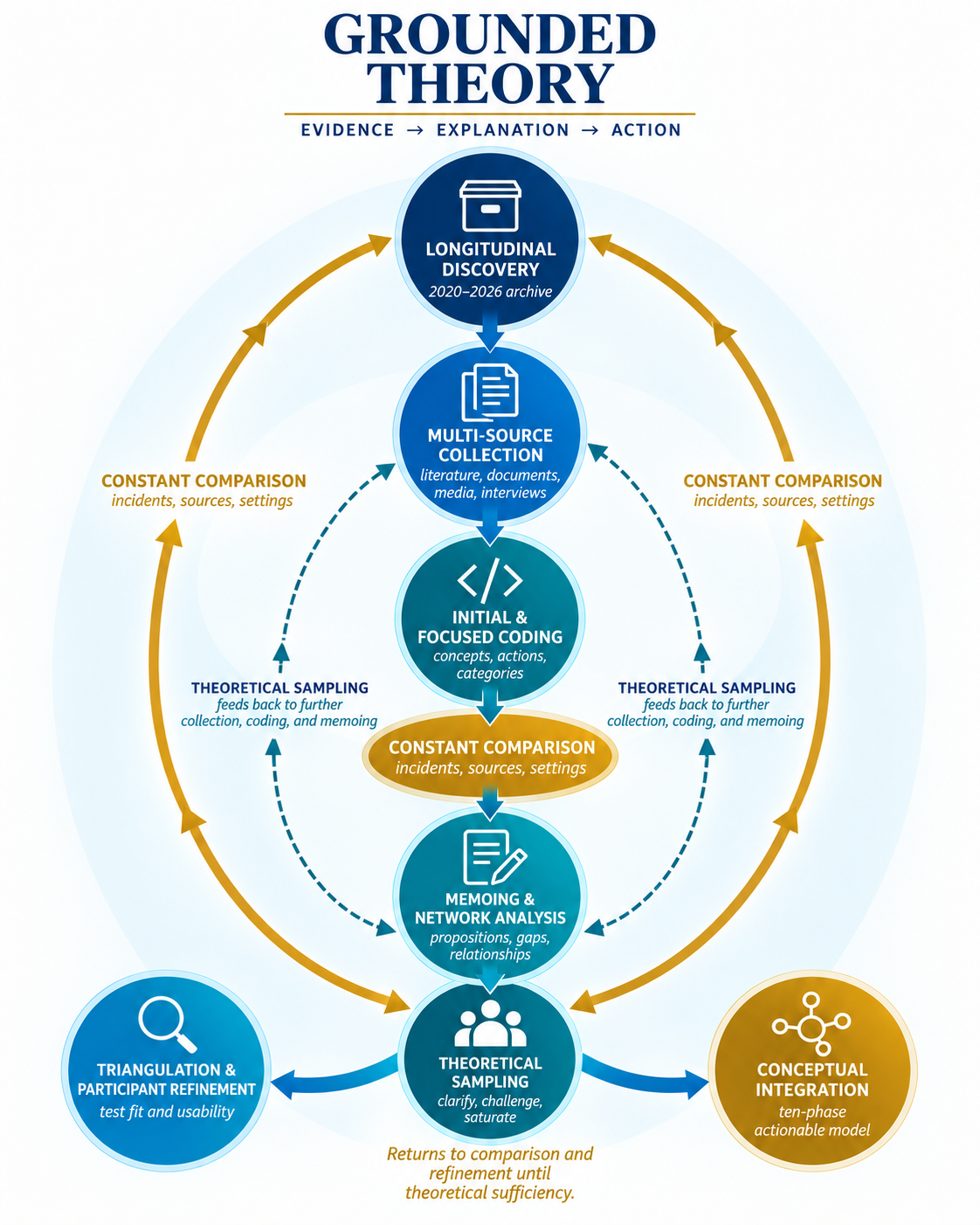
Evidence was collected, explored, and compared until a model emerged. A qualitative grounded theory design brought heterogeneous evidence into a disciplined cycle of coding, memoing, comparison, triangulation, validation, and refinement
800+scholarly articles
30K+public and industry sources
1K+transcribed media sources
2020–26discovery archive
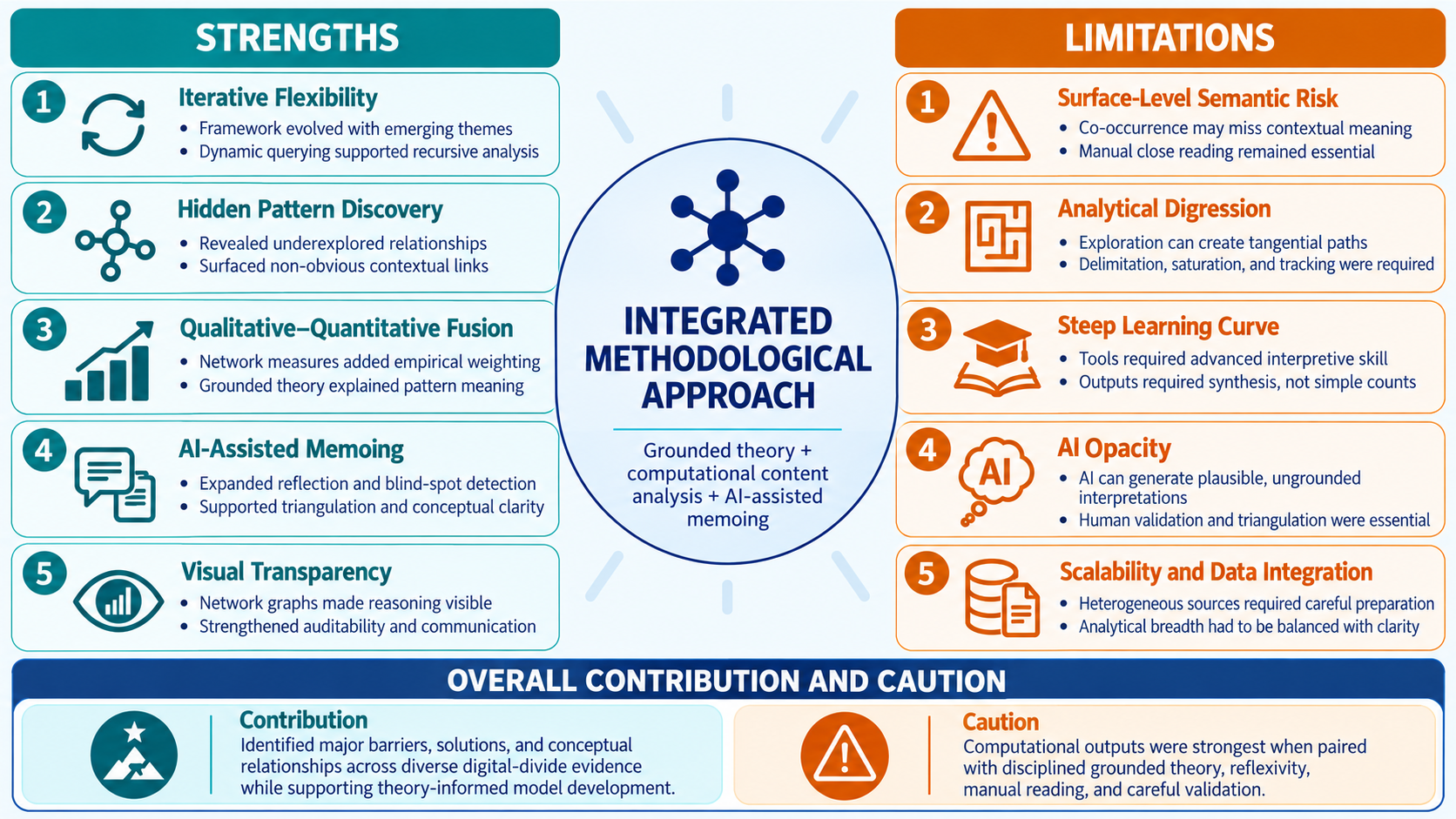
The integrated approach combined interpretive depth, computational pattern discovery, and AI-assisted reflection while preserving manual validation, reflexivity, and methodological caution.
Sources of data
An evidence ecosystem–not a single dataset.
The study followed the digital divide as an evolving phenomenon from 2020 through 2026. It combined human experience with policy, institutional, technical, corporate, media, scholarly, and contextual evidence so that emerging explanations could be compared across people, places, sectors, and levels of decision-making. In grounded theory, analytically useful data may take many forms when it helps explain the phenomenon under study (Glaser & Strauss, 1967; Rapley, 2018).
01
Discovery and longitudinal public discourse
The evidentiary foundation began with automated Google Alerts on the digital divide, broadband access, digital equity, educational technology, digital literacy, and related initiatives. More than 30,000 entries traced changes in projects, programs, technologies, organizations, policy debates, and public language; more than 14,000 were reviewed manually and programmatically. These records supported the first codebook and allowed each new item to confirm, extend, divide, or challenge an emerging category. A curated collection of popular-media and online resources, reports, publications, and supplemental research then supplied implementation examples and filled gaps identified through theoretical sampling.
02
Scholarly, technical, government, and corporate documents
Peer-reviewed scholarship provided theoretical and empirical grounding across disciplines. Technology-focused material examined networks, infrastructure, devices, platforms, accessibility, cybersecurity, and emerging technologies. Government and congressional research, FCC material, and state digital-equity and BEAD plans supplied legislative, regulatory, funding, mapping, affordability, universal-service, and implementation perspectives. The national policy comparison covered all 50 states through 178 planning documents. Industry reports and 105 SEC Forms 10-K and 6-K added evidence about markets, investment, risk, deployment cost, organizational priorities, and strategic constraints.
03
Recorded public knowledge
The study assembled 1,432 YouTube videos and other public recordings representing more than 800 hours of webinars, panels, conference sessions, community forums, policy briefings, organizational presentations, practitioner interviews, and other public discourse. Recordings were transcribed when needed and coded alongside written documents. This made it possible to compare formal policy language with the language used by educators, policymakers, advocates, technologists, community organizations, and implementation practitioners.
04
Interviews, questionnaires, and model refinement
Fifteen interview sessions involved 14 unique participants, with 14 interviews included in the formally coded collection. Ten participants also completed the Digital Divide Content Questionnaire. Interviews supplied experiential and professional accounts of how infrastructure, affordability, devices, skills, usability, trust, geography, culture, accessibility, institutional capacity, and policy interact. Questionnaires recorded judgments about barriers, solutions, and post-access conditions. These participant sources were used to elaborate categories, test relationships, clarify concepts, and refine the model–not to make population-level statistical claims.
05
Federal quantitative context
FCC, U.S. Census Bureau, and American Community Survey datasets added demographic, geographic, connectivity, adoption, household, and socioeconomic context, particularly for Arizona and the Phoenix metropolitan region. They helped assess whether qualitative categories such as affordability, geographic isolation, infrastructure availability, disability, language, and socioeconomic disadvantage were consistent with observable community conditions. These datasets contextualized and compared the qualitative findings; they did not convert the study into a mixed-methods or fixed-variable design.
06
Researcher-generated analytic evidence
Spreadsheets, source tags, evolving codebooks, analytic memos, comparison matrices, diagrams, text-network maps, model versions, and an audit trail recorded how interpretations developed. NVivo supported detailed coding and source traceability; InfraNodus helped explore conceptual networks and gaps; custom and AI-assisted tools supported organization and memo exploration. These artifacts did not replace primary evidence or researcher judgment. They documented the analytical path and enabled claims to be returned to their sources, compared across streams, and revised when contradictions or negative cases appeared.
Analytical workflow
Collection and interpretation advanced together.
Grounded theory allowed emerging categories to influence what evidence was examined next. The model was not imposed at the beginning; it was progressively developed and tested.
01
Open exploration
Documents and public discourse surfaced concepts, language, stakeholders, barriers, solutions, and gaps.
02
Coding & memoing
Open, axial, and theoretical coding linked concepts while analytic memos recorded questions and emerging explanations.
03
Constant comparison
Evidence was compared across sources, settings, and emerging categories to test boundaries and relationships.
04
Text-network analysis
InfraNodus supported exploration of concept networks and gaps; AI-assisted memoing supported theme exploration.
05
Detailed coding
NVivo supported coding, triangulation, traceability, and detailed examination across the evidence corpus.
06
Participant refinement
Interviews and questionnaires tested model clarity, completeness, usability, stakeholder roles, and practical value.
Methodological underpinning
Why grounded theory?
The research question required more than a description of who was connected. It required an explanation of how barriers, institutions, technologies, decisions, and local conditions interact–and a model showing how solutions can produce meaningful and sustainable change.
01 · Purpose
From describing inequality to explaining change
Grounded theory is a systematic, inductive, and comparative methodology used to develop an explanatory theory or conceptual model from patterns that emerge through sustained engagement with data. Rather than beginning with a fixed hypothesis and testing whether the evidence conforms to it, the researcher moves iteratively among collection, coding, comparison, memo writing, theoretical sampling, and conceptual integration. Categories become more precise as incidents are compared with incidents, sources with sources, and emerging explanations with new evidence (Glaser & Strauss, 1967; Charmaz, 2014; Corbin & Strauss, 2015).
This orientation aligned with the study’s purpose: identifying barriers to closing the digital divide, identifying possible solutions, and explaining the mechanisms through which those solutions may reduce exclusion. The intended contribution was not simply a catalog of barriers or a summary of programs. It was an actionable conceptual model grounded in the language, experience, evidence, and relationships found across educational, governmental, community, technical, policy, and industry contexts.
02 · Fit with the problem
A method suited to a complex and changing divide
The digital divide is not a single variable separating connected from unconnected people. Infrastructure and devices remain important, but affordability, accessibility, skills, trust, support, language, learning design, institutional readiness, governance, privacy, cybersecurity, sustainability, geography, and power shape whether technical access becomes meaningful participation. The phenomenon is therefore socio-technical, institutional, educational, spatial, and dynamic.
Earlier research frequently relied on statistical datasets and narrow measures of internet or device access. Those sources are essential for identifying distributions and disparities, but they can flatten household and community experience, obscure local conditions, and isolate variables that operate together in practice. Digital-divide scholarship has also called for stronger theory, clearer concepts, interdisciplinary inquiry, and greater use of qualitative and longitudinal approaches (van Dijk, 2006). A later review similarly found that theoretical frameworks and qualitative research remained comparatively limited within information-systems research on the divide (Vassilakopoulou & Hustad, 2023).
Grounded theory offered a way to work across disciplines and scales–from the experience of a learner or household to the decisions of institutions, providers, funders, and policymakers. Its constant-comparative logic enabled differences among rural and urban settings, educational levels, populations, technologies, and implementation conditions to remain analytically visible while common categories and relationships were developed (Bryant & Charmaz, 2007; Charmaz, 2014).
03 · Design rationale
Why other approaches were not the primary design
Several qualitative designs could illuminate parts of the problem. They were considered seriously, but each placed the center of inquiry somewhere other than the development of a transferable explanatory and action model.
Phenomenology
Phenomenology could reveal the meaning of lived experience and how individuals encounter exclusion. Its emphasis on experience and researcher interpretation would be valuable for a bounded population, but the study needed to connect experience with institutions, technologies, policies, solutions, and implementation mechanisms across many settings. It also did not align as directly with the goal of generating an operational conceptual model (Usher & Jackson, 2014).
Qualitative description
Qualitative description could provide a faithful account of who, what, where, and when. It was less suited to the study’s need to move beyond current conditions toward an interpretive explanation of relationships, causal mechanisms, and what practitioners could do next (Sandelowski, 2000).
Case study
A case study could examine one program, institution, community, or a bounded set of sites in depth. However, a single case would have constrained the range of contexts, while even a multisite design would organize the inquiry around selected cases rather than around theory generation across a large, heterogeneous evidence base. Case study contributes rich contextual knowledge, but its relationship to theory depends on the purpose and design of the study (Hamilton & Corbett-Whittier, 2013; Tight, 2017).
Narrative inquiry
Narrative inquiry could preserve how participants construct meaning through personal stories and social relations. Those stories were important evidence, but individual story-making was not the study’s primary object. The research needed to integrate personal accounts with plans, policies, technical evidence, organizational records, public discourse, and implementation experience (Daiute, 2014; Ntinda, 2019).
Quantitative or fixed-variable design
Quantitative evidence can estimate prevalence, compare groups, test associations, and map disparities. It cannot by itself explain the full interplay of barriers, decisions, context, and lived experience required to build the proposed model. Because the study did not begin with a stable set of variables or a predetermined causal hypothesis, a fixed-variable design would have narrowed the inquiry too early.
Grounded theory
Grounded theory directly matched the intended outcome: categories and relationships could emerge inductively, be tested through constant comparison and theoretical sampling, and be integrated into a coherent explanatory model. The method supported both depth and breadth without reducing the phenomenon to one site, one population, one narrative, or one level of access.
04 · Application
How grounded theory operated in the study
Data collection and analysis advanced together. Early documents and public discourse surfaced initial language, barriers, solutions, stakeholders, and gaps. Those findings shaped later searches, source selection, interviews, questionnaires, and model-review activities. This recursive process reflects theoretical sampling: subsequent evidence is sought because it can clarify, challenge, extend, or saturate an emerging category (Charmaz, 2014; Glaser & Strauss, 1967).
Initial coding remained close to the evidence and named actions, conditions, experiences, and concepts. Focused coding consolidated the most significant and recurring codes. Axial analysis examined relationships among conditions, actions, consequences, stakeholders, and contexts. Theoretical coding then connected substantive categories into a coherent explanation. Throughout the process, analytic memos documented decisions, questions, contradictions, negative cases, conceptual shifts, and possible relationships (Charmaz, 2014; Corbin & Strauss, 2015).
1CollectGather heterogeneous evidence
2CodeName concepts and actions
3CompareTest similarities and differences
4MemoDevelop analytic propositions
5SamplePursue gaps and contradictions
6IntegrateBuild and refine the model
The study extended traditional qualitative practice with computer-assisted qualitative data analysis, text-network analysis, and AI-assisted memoing. These tools helped organize sources, visualize conceptual proximity, surface alternative interpretations, and manage scale. They did not replace researcher judgment. Interpretations were returned to source material, compared across evidence streams, and assessed for fit, relevance, and explanatory power. This preserved grounded theory as the governing logic of inquiry while using computational tools as analytic supports.
05 · Rigor
Evidence was not treated as a vote count
In grounded theory, frequency can identify prominence, but frequency alone does not establish theoretical significance. A less common account may expose a boundary condition, inequitable burden, hidden mechanism, or negative case that requires the emerging explanation to change. The analysis therefore considered the quality, context, meaning, and relationships within evidence–not only how often a term appeared.
Credibility was strengthened through constant comparison, multiple evidence streams, memoing, source traceability, participant refinement, and repeated revision of categories and models. Dependability was supported through documented analytic procedures and an audit trail. Transferability was addressed through sufficiently detailed descriptions of contexts, populations, conditions, and mechanisms so readers can judge whether the model fits another setting. Confirmability required interpretations to remain anchored to evidence while researcher assumptions, tool-supported insights, and limitations were made explicit (Charmaz & Thornberg, 2021; Miles et al., 2020).
The resulting model is therefore neither a universal formula nor a claim that every intervention requires every possible solution. It is a grounded explanatory and action framework: a disciplined way to diagnose a divide, identify affected populations and systems, compare options, test strategic fit, govern implementation, distinguish outputs from outcomes, and return new evidence to earlier decisions.
06 · Trustworthiness
Credibility came from convergence–not volume alone.
The study attended to credibility, dependability, transferability, and confirmability through documentation, comparison, triangulation, transparent analytical procedures, and explicit limitations.
Interpretive boundary: The questionnaire sample was small and highly knowledgeable. Its results provide descriptive and conceptual insight, not population-level estimates. Aggregate data limited subgroup analysis and respondent-level linkage.