What barriers are causing the digital divide?
Identify technical, economic, geographic, educational, cultural, psychological, and institutional conditions.
The arc of inquiry
The study began with a persistent question about solutions for K–College students. Six years of discovery revealed that the answer could not be reduced to broadband deployment.
Questions guiding the study
The three questions deliberately move from diagnosis to intervention and then to evidence of change.
Identify technical, economic, geographic, educational, cultural, psychological, and institutional conditions.
Identify coordinated interventions and the contexts in which they can work.
Explain what makes solutions effective, how change occurs, and what outcomes justify continuation.
An evolving definition
Early definitions made a vital inequality visible: some households possessed telecommunications and computing resources while others did not. As access spread, scholarship showed that a binary “connected or not connected” measure could not explain differences in skills, quality of use, participation, or benefit.
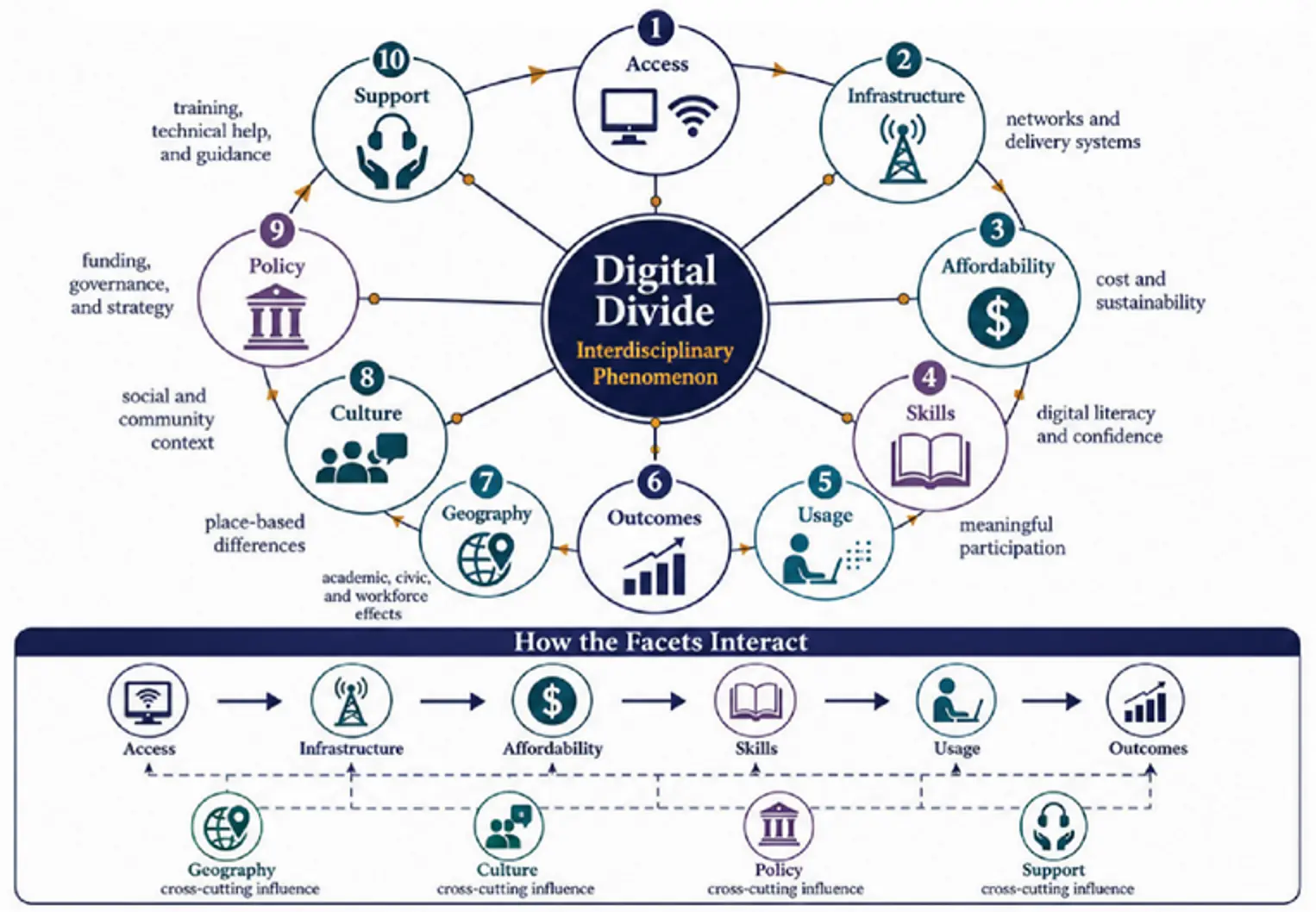
The dissertation follows this intellectual progression and extends it into a systems definition. The divide is not one gap or a stable endpoint. It is produced through interacting technical, economic, social, educational, institutional, cultural, and personal conditions–and is closed only when access can be converted into meaningful, equitable, and sustainable outcomes.
The definitions examined in the dissertation also show that the field did not simply replace access with skills or outcomes. Earlier and later meanings coexist: physical availability and affordability remain essential, while devices, support, motivation, institutional readiness, accessibility, and the capacity to benefit explain why connection alone does not produce equal participation. The developing definition is therefore cumulative, retaining unresolved access gaps while incorporating the conditions that shape adoption, use, and outcomes.
“The digital divide is the gap between those who have affordable access, skills, and support to effectively engage online and those who do not.”National Digital Inclusion Alliance, Definitions
Who has telephone, computer, and Internet access–and who remains among the information “have nots”?
NTIA, 1995, 1999How do gaps differ across people, households, businesses, places, socioeconomic levels, and opportunities to use ICT?
OECD, 2001What can people actually do online, and how are technology, literacy, resources, institutions, and social context integrated?
Hargittai, 2002; Warschauer, 2003; van Dijk, 2006Who converts access, skills, and use into educational, economic, social, cultural, and personal benefits?
van Deursen & Helsper, 2015; van Deursen & van Dijk, 2019Is access affordable, reliable, safe, available through an appropriate device, and supported by adequate skills?
ITU, 2022How do infrastructure, affordability, devices, skills, trust, accessibility, institutions, policy, support, and lived conditions interact–and which coordinated actions create durable change?
Ross, 2026Reading the definition as a system
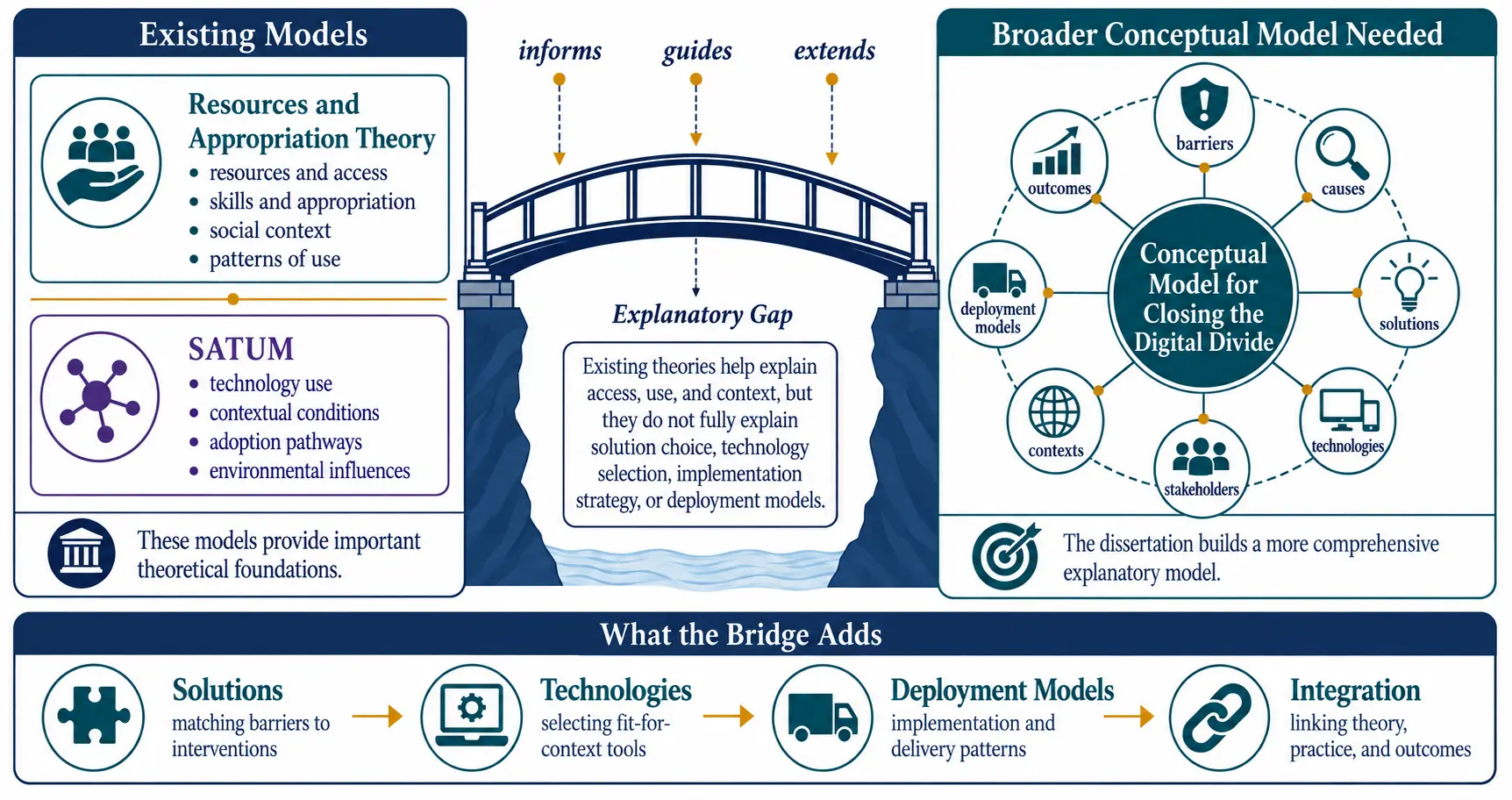
The graphical evidence shows why no single definition is sufficient. Each view adds a different layer: the language used to name the divide, the relationships among its facets, the explanatory limits of earlier models, and the historical accumulation of new concerns.
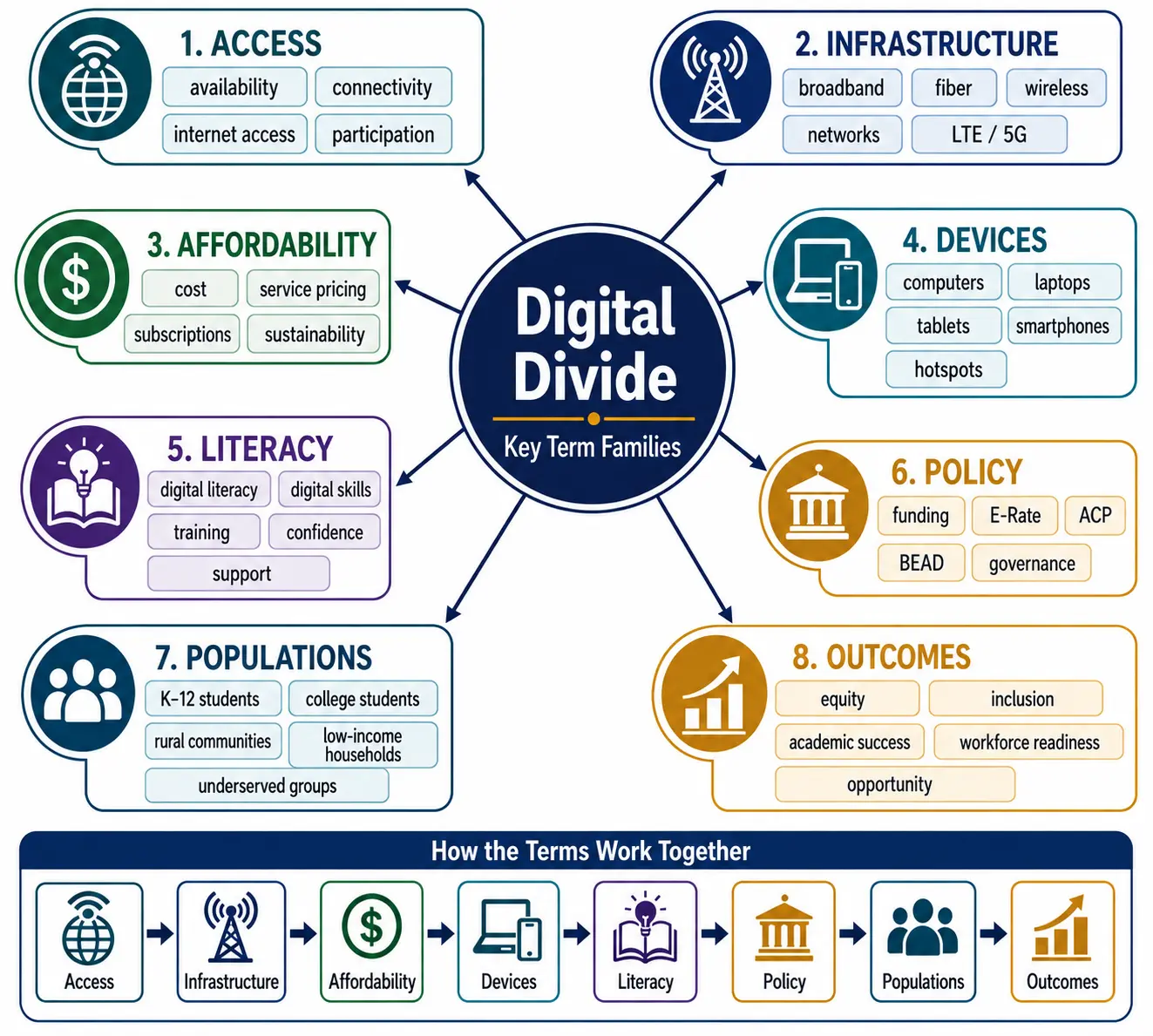
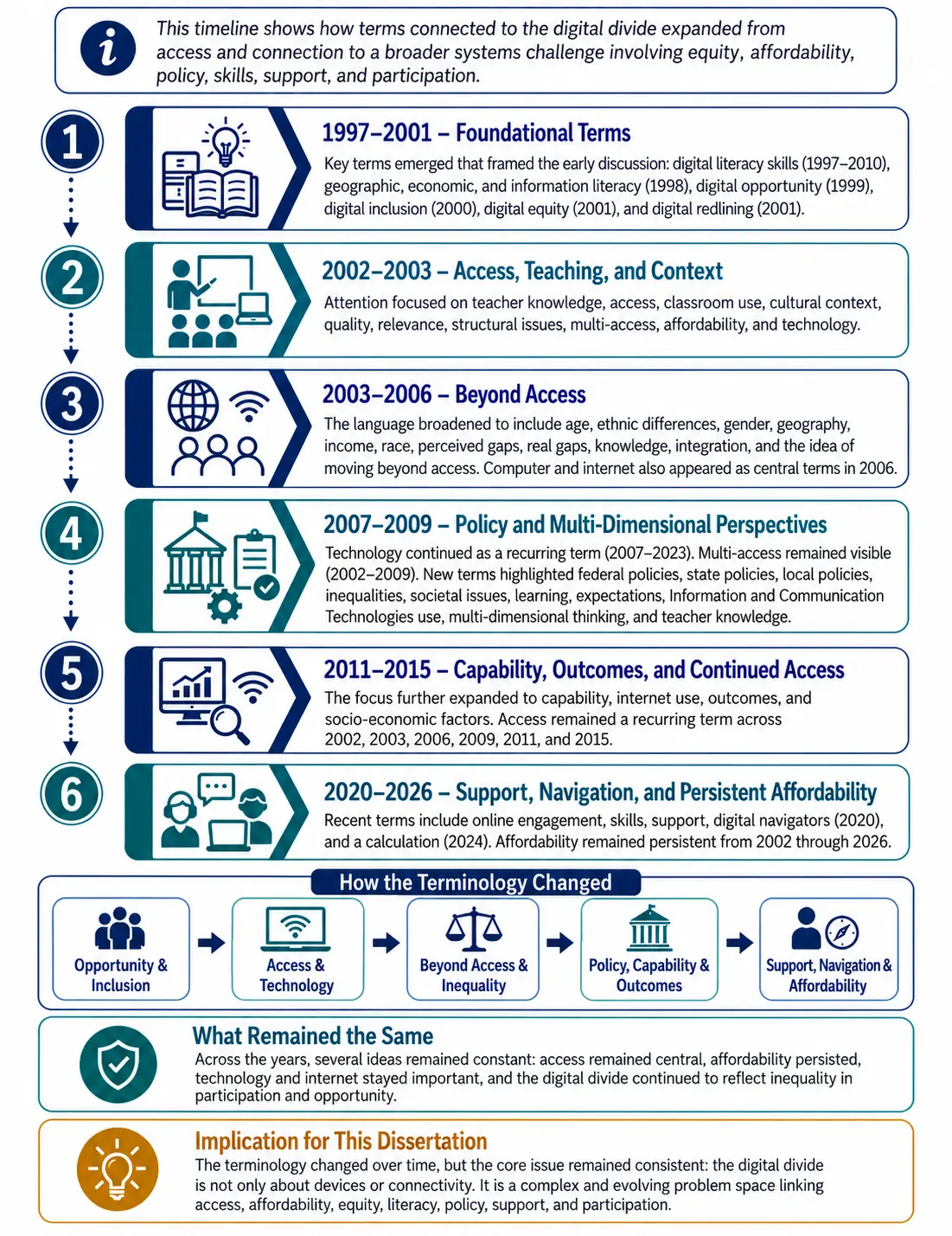
Working definition from the study
The digital divide is a dynamic systems condition in which unequal access, capability, support, participation, and institutional readiness constrain people’s ability to convert digital technologies into meaningful and sustainable opportunity.
This synthesis reframes closure as a causal and evaluative question. Providing a connection is an essential output; closing the divide requires evidence that people can reliably, safely, affordably, and equitably use the wider service system to achieve outcomes they value.
Hargittai, E. (2002). Second-level digital divide: Differences in people’s online skills. First Monday, 7(4).
International Telecommunication Union. (2022). Framework for universal and meaningful connectivity.
National Digital Inclusion Alliance. (n.d.). Definitions.
National Telecommunications and Information Administration. (1995). Falling through the Net: A survey of the “have nots” in rural and urban America .
Organisation for Economic Co-operation and Development. (2001). Understanding the digital divide .
van Deursen, A. J. A. M., & Helsper, E. J. (2015). The third-level digital divide: Who benefits most from being online? In Communication and Information Technologies Annual (Vol. 9, pp. 29–52).
van Deursen, A. J. A. M., & van Dijk, J. A. G. M. (2019). The first-level digital divide shifts from inequalities in physical access to inequalities in material access. New Media & Society, 21(2), 354–375.
van Dijk, J. A. G. M. (2006). Digital divide research, achievements and shortcomings. Poetics, 34(4–5), 221–235.
Warschauer, M. (2003). Technology and social inclusion: Rethinking the digital divide . MIT Press.
Ross, P. (2026). Solutions Beyond Access: A Grounded Theory Model for Closing the Digital Divide [Doctoral dissertation]. Grand Canyon University.
The intellectual shift
The study stopped asking, “Which technology should we deploy?” and began asking, “What problem are we actually solving?”
Core chapters
The website reorganizes the content by reader purpose. The dissertation retains the complete academic record, citations, instruments, codebooks, methods, analysis, and supporting materials.
Background, problem, definitions, scope, limitations, and study organization.
The problem space, theoretical foundations, barriers, infrastructure, policy, literacy, inequities, and the research gap.
Grounded theory design, population, sampling, evidence sources, trustworthiness, collection, analysis, and ethics.
Integrated analysis, interviews, questionnaires, content analysis, research-question findings, model development, and simulations.
Findings, implications, strengths, limits, future research, recommendations, practice, and holistic reflection.
Beyond the chapters
Supporting materials connect the academic record to six reusable areas.
Recruitment, consent, interview guides, questionnaires, and protocols.
Codebooks, grounded theory process, protocols, tools, and scripts.
Stakeholder inventories across governance, learning, technology, and support.
Conceptual iterations, practitioner views, and the ten-phase narrative.
Application across education, workforce, governance, risk, and equity.
Six comparative cases and detailed implementation frameworks.
Contribution
A conceptual model becomes valuable when it helps people make better decisions in materially different contexts.
The dissertation contributes an interdisciplinary explanation of the divide, a governance-ready planning architecture, a balanced measurement approach, and evidence of transferability across multiple fields.