1 · Frame the decision
- State the problem without naming a solution.
- Identify who experiences it and how.
- Separate evidence, assumptions, and gaps.
Research in use
This guide translates the conceptual model into a practical sequence for education leaders, communities, providers, policymakers, funders, and cross-sector partnerships.

A working sequence
The process can scale from a school initiative to a regional broadband program. The depth changes; the core decisions remain.
From model to disciplined practice
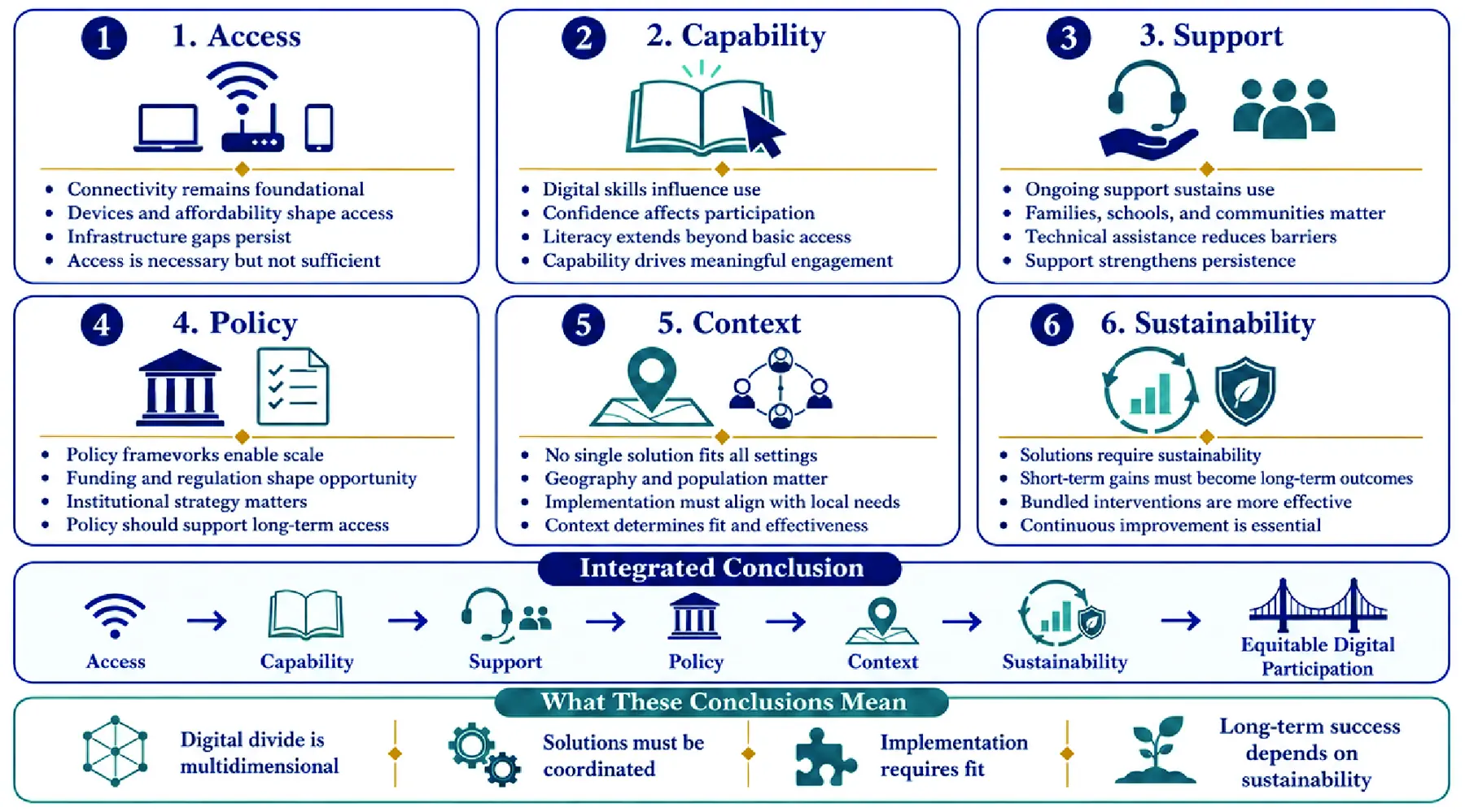
The dissertation’s central practical implication is that infrastructure, devices, skills, support, accessibility, trust, policy, institutional capacity, and lived experience must be treated as one changing system. Each decision should therefore be explicit, reviewable, and capable of being revised when evidence changes.
Connect every intervention component to a validated barrier, affected population, causal mechanism, accountable owner, and expected outcome.
Do not assume that a program effective in one place will transfer unchanged. Test geography, culture, institutions, markets, policy, workforce, timing, and trust.
Include people who experience the divide in problem definition, option review, implementation learning, and evaluation–not only as end users.
Plan for operations, maintenance, replacement, support, data stewardship, accessibility, security, workforce, and funding after launch.
Required working record
These are living records. They should be revised at decision points and whenever implementation reveals a changed condition, an unequal effect, or a broken assumption.
Defines the observed problem, affected populations, boundaries, evidence quality, inequities, exclusions, assumptions, and unresolved questions–without prematurely naming a preferred product.
Records who experiences, influences, funds, authorizes, delivers, maintains, resists, and evaluates the work, including groups with high impact but limited formal authority.
Tracks enabling and adverse conditions, policy requirements, market constraints, institutional readiness, timing, staffing, trusted intermediaries, and dependencies that could alter performance.
Translates evidence into functional, service, network, device, data, identity, privacy, security, interoperability, accessibility, support, resilience, procurement, and lifecycle requirements.
Documents current conditions and shows how the proposed action is expected to move from resources and activities to use, capability, participation, and measurable benefit.
Preserves evidence considered, alternatives, gate-test conclusions, confidence, dissent, assumptions, risks, mitigations, ownership, conditions, dates, and the final disposition.
Defines indicators, baselines, targets, disaggregation, data owners, collection cadence, quality rules, interpretation responsibilities, feedback triggers, and corrective-action routines.
Strategic Decision Gate
The gate sits between diagnosis and detailed design. An option advances only when evidence supports its causal logic and the delivery system can carry it responsibly.
Which diagnosed barrier does this option change? What evidence supports that mechanism, and what competing explanation remains?
Is the need sufficiently important and timely, and are expected benefits equitably distributed across priority populations?
Are authority, capacity, workforce, partners, schedule, procurement, funding, and institutional readiness adequate?
Is the architecture accessible, secure, interoperable, reliable, supportable, scalable, resilient, and appropriate to the context?
Are privacy, cybersecurity, accessibility, safety, ethics, trust, burden, exclusion, and recourse addressed before implementation?
Do expected benefits justify total lifecycle cost, and can operations, support, governance, workforce, and funding endure?
Measurement architecture
Counts matter, but they become evidence of closure only when they can be connected to sustained participation and outcomes for the intended population.
Funding, people, partners, infrastructure, data, authority.
Build, enroll, distribute, train, support, engage, govern.
Sites, devices, participants, service contacts, curricula.
Reliable use, affordability, skills, confidence, trust, accessibility.
Learning continuity, service access, mobility, well-being, participation.
What worked, for whom, under which conditions, at what cost.
Review results by population and place wherever ethical and statistically appropriate. An improving average can conceal worsening outcomes for people with disabilities, rural residents, low-income households, language communities, older adults, or learners in unstable housing.
Agree in advance which signals require reframing, redesign, escalation, additional engagement, a new safeguard, a return to the gate, or discontinuation. Continuous learning is a governance responsibility, not an end-of-project exercise.
Implementation review cadence
A regular cadence prevents the model from becoming a one-time planning exercise and keeps new evidence connected to authority and action.
Review delivery issues, support demand, service interruptions, accessibility failures, emerging harms, and corrective actions.
Examine leading indicators, unequal effects, data quality, assumptions, partner performance, risks, and changes in local conditions.
Confirm readiness, release the next stage, revise scope, add safeguards, reallocate resources, pause, or return the option to the strategic gate.
Determine what changed, why, for whom, and whether benefits, value, support, trust, and institutional capacity can be sustained.
Balanced measurement
A project can finish on time and still fail to close the divide. Construction and program activity must be linked to changes in human capability and institutional performance.
Miles built · sites activated · devices distributed · people trained · help-desk contacts · curricula created · partnerships signed.
Reliable use · sustained affordability · digital confidence · accessible participation · educational continuity · workforce mobility · trust · satisfaction · durable community capacity.
Audience entry points
No stakeholder owns the whole system. The model provides shared structure while preserving role-specific accountability.
Which learners can connect but still cannot participate? Examine continuity, devices, educator readiness, accessibility, family context, safety, and support.
Whose experience and authority are absent from the problem definition? Map place, assets, trust, institutional capacity, and local ownership.
Which nontechnical conditions prevent the network or platform from creating value? Measure delivered experience, support, accessibility, and choice.
Does the intervention fit the cause, population, delivery capacity, safeguards, total cost, and durable public value?
Where do people encounter friction after access? Track skills, confidence, repair, privacy, language, trust, and referral pathways.
What causal claims are being made, what evidence would test them, and how do context and power affect interpretation?
Contribution
A conceptual model becomes valuable when it helps people make better decisions in materially different contexts.
The dissertation contributes an interdisciplinary explanation of the divide, a governance-ready planning architecture, a balanced measurement approach, and evidence of transferability across multiple fields.